


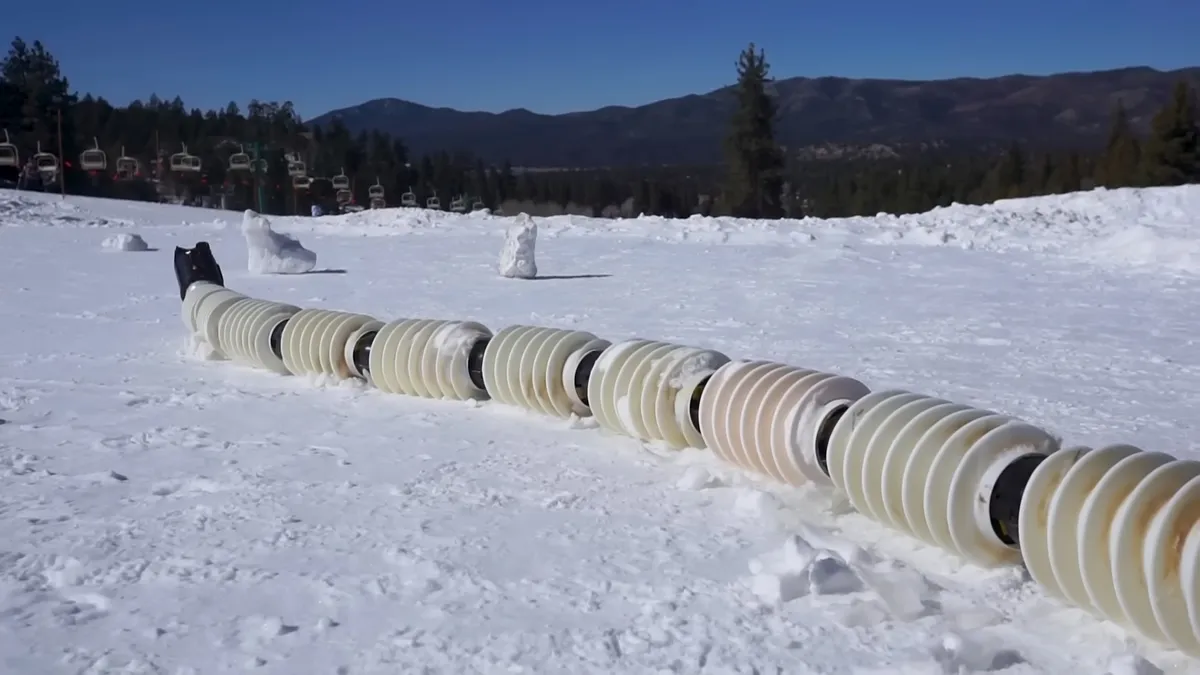
NASA is currently testing an autonomous snake robot, which looks to have a lot of potential as an alternative to current Rover units. Dubbed the Exobiology Extant Life Surveyor (EELS), the project aims to create a robot that can handle much more extreme terrain than its predecessors.
The project came to life through the "desire to look for signs of life in the ocean hiding below the icy crust of Saturn’s moon Enceladus". That's how NASA's Jet Propulsion Lab tells the story, anyway (via Universe Today).
With the difficult goal of traversing Enceladus' rough terrain set—which would involve checking for extraterrestrial life inside the vents of geysers strong enough to blast vapour into space—EELS had its work cut out. So far, that goal has birthed an extremely resilient, versatile robot that looks like it can go just about anywhere.
"There is no textbook about how to design an autonomous snake robot to boldly go where no robot has gone before. We have to write our own", says Hiro Ono, EELS principal investigator.
Right now, the prototype is 220 pounds, 13 feet long, and is propelled by screw-like segments, with a nifty grabber for a head. With features like this, NASA's wiggly, would-be pilgrim has the ability to reach spots that Rover robots could never dream of. Not only can it climb steeper slopes and cliff faces, skate across perilous ice sheets, and navigate "labyrinthine spaces within glaciers", it even has the ability to brave lava tubes.





Best CPU for gaming: The top chips from Intel and AMD
Best gaming motherboard: The right boards
Best graphics card: Your perfect pixel-pusher awaits
Best SSD for gaming: Get into the game ahead of the rest
Eventually, the plan is to make it do all this autonomously, making decisions on the fly while digitally mapping its surroundings.
"When you’re going places where you don’t know what you’ll find, you want to send a versatile, risk-aware robot that’s prepared for uncertainty—and can make decisions on its own", says EELS project manager Matthew Robinson.
NASA is taking a startup approach to EELS, with rapid agile testing and quick, successive builds. It looks like EELS has already been through several iterations, and could end up looking much different to the pictures here when it comes to rocketing off-world into the far reaches of the solar system.

