Resident Evil director Paul W. S. Anderson says he's got no time for people who do game adaptations without playing them—'That's outrageous'
And also finds time to demolish that awful Doom movie.
Keep up to date with the most important stories and the best deals, as picked by the PC Gamer team.
You are now subscribed
Your newsletter sign-up was successful
Want to add more newsletters?
Director Paul W. S. Anderson, who helmed the likes of Mortal Kombat (1995), Resident Evil (2002), and Monster Hunter (2021), has just done a new interview on Chris Plante's (excellent) podcast Post Games. It's a lengthy and enjoyable listen, and Anderson speaks at some length about the thought process behind that first Resident Evil movie (which is not only underrated, but kicked off a series of films that have now collectively grossed well over a billion dollars).
One of the interesting aspects of the interview is that Anderson is very clearly a big gamer, something that shines out of the Resident Evil movies in particular, and his love for the source material is obvious. That's not a given: videogame movies are now big business, partly thanks to Anderson, but for example Jason Momoa adopted the bold marketing strategy of telling everyone he didn't game and wouldn't let his kids play Minecraft while promoting The Minecraft Movie.
"I think it's important for me to be a fan," says Anderson. "You know, it always shocks me when directors give interviews and they're doing a videogame movie and go, 'well, I never played the game'. Like, that's outrageous! You know, would you adapt War and Peace and say, 'you know, I never read the book: I've got the script, it's fine, I shot that, the book I'm not interested in.'
"I feel like it's doing a disservice to the people who love the game and have invested many hours and days and months of their time into this world for you to ignore it. So I think for me, it's very important for the people who are doing an adaptation to have a real awareness of what they're adapting. And I would say what's really important as well is the aesthetic of it."
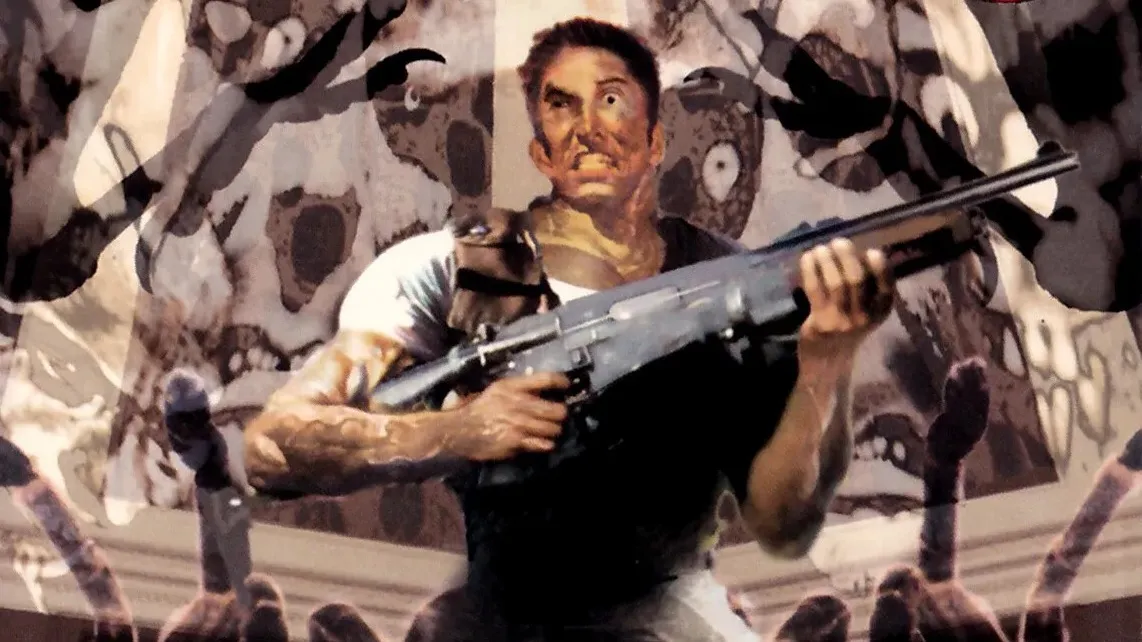
This is one of the aspects of Anderson's movies I've always enjoyed. I'm not saying they're all classics but, if you've played the original Resident Evil games and then watched the movie, there are so many nods and cinematic versions of the games' style and visual language. Turns out Anderson puts everyone through boot camp.
"I always make sure the production designers I work with play the game or watch playthroughs of the game, so they know what it looks like, and the director of photography knows how the camera moves," says Anderson. "In a lot of videogames that overhead shot, the top-down look of a room where it's a grid, is very, very important. Resident Evil—going through doorways, obviously very important. Pushing through a proscenium arch, into a scene…

"All of those things are present in my movies because they're present in the games that I've adapted. I make sure the entire crew are immersed with all of that as well, so if you're a fan of the game you really feel like the DNA of the game is built into the film you're watching. I think that buys you a lot of goodwill.
Keep up to date with the most important stories and the best deals, as picked by the PC Gamer team.
"I saw it when I did Mortal Kombat. We built one set where Liu Kang fights Reptile, a set that's called the pit, and built it exactly from the videogame: the same window, the same tables, like it's exactly from the game. And I remember we're screening the movie, like one guy stood up and went 'the pit!', and the whole audience cheered. And I'm like, Yeah, okay, we nailed it."
With that said, Anderson has a clear-eyed view of what's useful to take directly from a game, and what movies do differently.
"The experience, the interactivity of playing a game is completely different to being passive and sitting in a cinema and watching," says Anderson. "To play a game probably takes 15 hours for me, 48 hours in a week, because I'm slow, but a movie is two hours. They're different kinds of visceral experiences.
"There's a lot of trudging around in videogames and solving puzzles and things. You don't want to do that in a movie, you want more of a kind of kinetic experience. You don't want to completely emulate the videogame experience. I watched Doom, with Dwayne Johnson, and in the last act, there's a whole reel that goes into first person shooter mode. And I guess the thought process was, well, that's what the videogame looks like. The fans will love it!
"But the fans didn't love it, because in a game you're controlling it, you're making these decisions. You have an investment in it, [rather than] just watching it from a passive way. You didn't have any investment so, visually, it was delivering what the games delivered, but viscerally it was not. That's an important differentiation."
Anderson is done with the Resident Evil series, but acknowledges that it's now one of those "forever franchises" that will see new entries for probably as long as we all live. "That's what I said to everyone when we were working on Alien Versus Predator, all the actors, I said 'really enjoy this, because you're going to be a part of this pop culture phenomena forever.'
"Because once you make AVP, and it works, because I was very confident about that movie, they're going to start making Alien movies again, and they're going to start making Predator movies again, and they're going to go on forever. And sure enough, after AVP kicked ass, they kind of rebooted the Predator franchise and the Alien franchise, and they're still going strong. It's wonderful to be a part of those big pop culture franchises, but it's certainly not for me to kind of like lay down the law as to what should and shouldn't be done."
Anderson also makes the point that, even though games are now a million times more lavish and beautiful than their 90s counterparts (which is when he started directing videogame adaptations), the audience were "just as invested when it was kind of low res graphics."
With that said, obviously the fact Resident Evil is now a series with three decades of history does make a difference. "But I think the mechanics for me of adapting a videogame, pretty much, are the principles that I laid down already," says Anderson.
"Respect for the IP, understanding what an audience gets out of playing the game. For Resident Evil, it was the visceral thrill of shooting things, but also it was scary, and that's why I had to make a scary movie. You know, I remember playing Resident Evil when the dogs jumped through the window for the first time and the PlayStation controller vibrated. I shot out of my skin.
"It was scary, and I thought 'I have to make a scary movie because the game is scary' and that's one of the things it delivers to the audience, is those scares. That's why I couldn't do just a straight adaptation, because it wouldn't have scared anybody, because they'd have known exactly when the dog was going to jump through the window and they'd be prepared for the scares. I don't want to rob the audience of that, because that's part of the experience of playing the game that should be ported into the movie version."
The full podcast episode has much more about Mortal Kombat, Resident Evil, and Paul W.S. Anderson's thoughts on all sorts of things. It is a great listen.

2025 games: This year's upcoming releases
Best PC games: Our all-time favorites
Free PC games: Freebie fest
Best FPS games: Finest gunplay
Best RPGs: Grand adventures
Best co-op games: Better together

Rich is a games journalist with 15 years' experience, beginning his career on Edge magazine before working for a wide range of outlets, including Ars Technica, Eurogamer, GamesRadar+, Gamespot, the Guardian, IGN, the New Statesman, Polygon, and Vice. He was the editor of Kotaku UK, the UK arm of Kotaku, for three years before joining PC Gamer. He is the author of a Brief History of Video Games, a full history of the medium, which the Midwest Book Review described as "[a] must-read for serious minded game historians and curious video game connoisseurs alike."
You must confirm your public display name before commenting
Please logout and then login again, you will then be prompted to enter your display name.