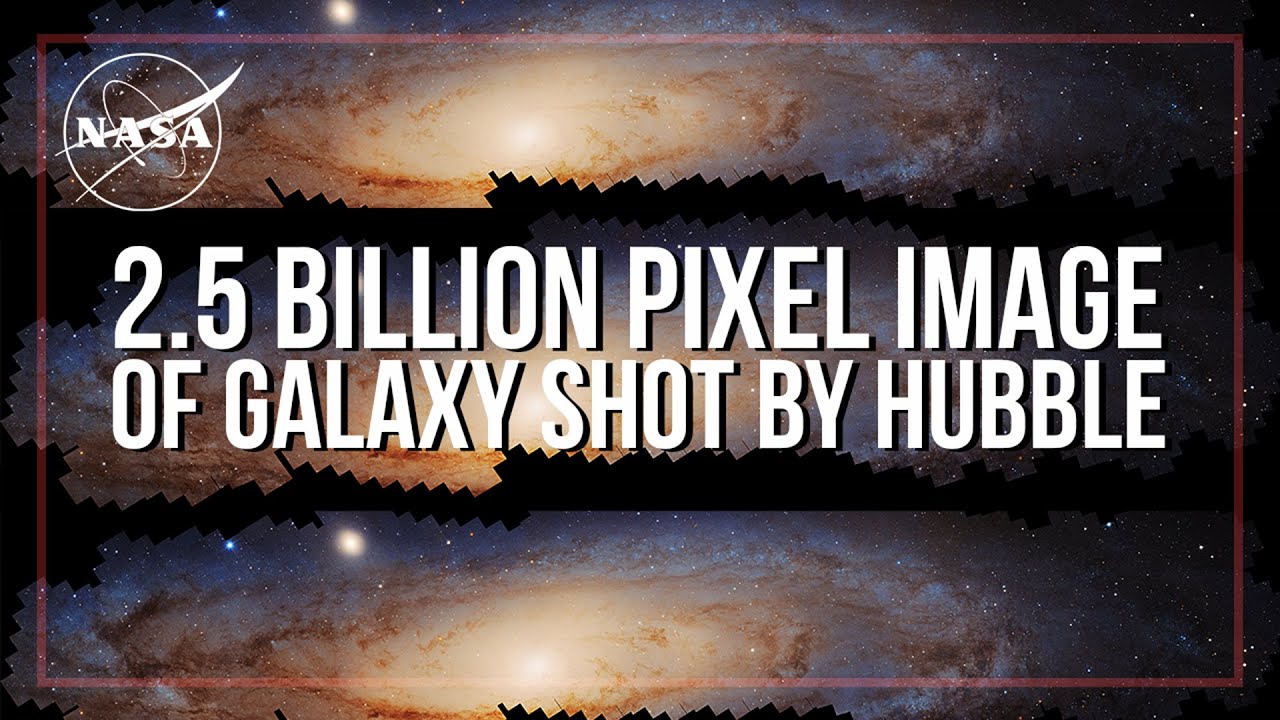
The Hubble Space Telescope has been snapping pictures of the universe for the best part of 35 years, and now astronomers have completed a magnificent 417-megapixel photomosaic of the Andromeda galaxy. And the key takeaway? It's a galactic "trainwreck."
The 42,208 by 9,870 pixel panorama features 200 million stars, a mere fraction of the one trillion stars in the Andromeda galaxy overall (via PetaPixel). The galaxy was originally believed to be part of our very own Milky Way, but it was Edwin Hubble himself who first determined that it was a separate entity, confirming that the Milky Way was not the extent of the universe and furthering our understanding of the vast darkness in which we exist.
Now, thanks to over 1,000 Hubble orbits and a decade's worth of snaps, we've got our most complete view of it yet. And according to Daniel Weisz, associate professor of astronomy at the University of California: “Andromeda’s a train wreck. It looks like it has been through some kind of event that caused it to form a lot of stars and then just shut down.
“This was probably due to a collision with another galaxy in the neighborhood.”
The chief potential culprit of the galaxy's apparent state of disarray is the compact satellite galaxy Messier 32, which seems appropriately named given the circumstances. Simulations have suggested that when two galaxies run into each other, one can use up the interstellar gas of the other, causing star formation to stall and stop and leaving it, in British parlance, in a bit of a state.
Messier 32 resembles the stripped-down core of an ex-spiral galaxy in the nearby vicinity, suggesting the two may have had a coming together in the distant past.
Weisz continues: “Andromeda looks like a transitional type of galaxy that’s between a star-forming spiral and a sort of elliptical galaxy dominated by aging red stars.
“We can tell it’s got this big central bulge of older stars and a star-forming disk that’s not as active as you might expect given the galaxy’s mass.”

So, Andromeda appears to be frozen in time in a relatively "unfinished" state. Regardless, it's still a stunning view to someone not as familiar with the ways a galaxy might organise itself, ie yours truly.
Hubble's getting on in years on a human-based timescale, and contenders like the James Webb Space Telescope are scanning the universe for similar views. The upcoming Nancy Grace Roman Space Telescope is currently due to launch in May 2027, and should give us an even better look at specific regions of space and our nearest galaxies.
Best gaming PC: The top pre-built machines.
Best gaming laptop: Great devices for mobile gaming.
Its stated mission is to search for extra-solar planets using gravitational microlensing as well as probing the chronology of the universe and the growth of cosmic structure—so its superior hardware may eventually give us an even better look at what exactly is going on with Andromeda in years to come.
In the meantime, nice space picture make hardware writer go wow. That's my personal takeaway, and also the reason why I primarily write about graphics cards for a living and not the vast reaches of space. Fabulous to look at, though, innit?