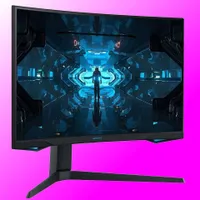
The best gaming monitors are engineering marvels, packed with millions of pixels, that can change colour quicker than you can imagine. You do need a decent graphics card to push them all around, though, but one inspired coder has a solution to this in the form of a game that just uses your monitor's subpixels.
As I write this, I'm currently staring at a 4K 27-inch monitor. The display comprises a little under 8.3 million pixels and, somewhat obviously, they're too small to make out by eye. But if you took a microscope or a camera with a decent macro lens, you'd instantly notice them and the fact that every pixel is a collection of three (sometimes four) even smaller pixels, one each for red, blue and green colour channels. They're called subpixels.
Fascinated by their own discovery, coder Patrick Gillespie (via Sweclockers) was inspired to create a version of Snake, the classic phone game, that worked entirely via a monitor's sub-pixels. In other words, rather than moving a snake comprising one or two full pixels around the screen, Gillespie worked out a way of doing just with subpixels.
If you want to know just what that would look like, you can try 'Subpixel Snake' for yourself on Gillespie's website or you can download the javascript code from GitHub, and compile it for your own hardware. There's just one teeny problem—unless you have eyes like Legolas, you'll barely notice a thing, which means you will almost certainly need a microscope (or a good macro lens).
And don't think you can just zoom your browser window all the way in, as the more you do this, the more the subpixels in the game's code won't align properly with your monitor's subpixels. In fact, you need to go the other way and have your browser window scrolled all the way out to ensure everything lines up. Well, you can try to zoom all the way in and even use a software tool to magnify that portion of the screen even more, but it just won't work correctly.
If all that seems like too much hassle, you can just watch the above YouTube video instead but it is well worth five minutes of your time anyway, as Gillespie explains how everything was done. Subpixel Snake doesn't serve any real practical purpose nor does it push the boundaries of game development further ahead, but to me, it's just a really neat endeavour.
I reckon anyone with an interest in becoming a game developer should try a similar project. In the same way that bedroom coders of the 1980s worked with limited colour palettes and tiny amounts of RAM, forcing yourself to work on modern, ultra-powerful hardware that's been massively constrained in terms of capability, will help you understand why and how things work. And just as with those old coders, it can lead to creating better games.
There's probably no career path to be found in the world of subpixel gaming, of course, but just think what kind of reaction you'd get at a game dev job interview when you pull out a microscope to show off the next big indie hit.