Join The Club





Director Paul W. S. Anderson didn't pioneer the videogame movie adaptation, but in the bad old days he was one of the very few to make decent (and commercially successful) movies out of adapting our blessed medium. I'm not going to say that stuff like Mortal Kombat (1995) or Resident Evil (2002) are high art, and there's some absolutely honking stuff in his later Resident Evil sequels, but Anderson's adaptations always felt like they understood the source material, particularly when it comes to cinematography and set design, and even the not-so-great ones are perfectly watchable.
High praise, I know. But this all has to be taken in the context of just how bad videogame movies were in the 90s: Anderson, by contrast, made his name with the unexpectedly entertaining Mortal Kombat, and the Resident Evil series of films he was instrumental in kicking off has collectively grossed well over a billion dollars. The latest episode of Chris Plante's (excellent) podcast Post Games features a lengthy interview with the director about his path into videogame movies, and a whole lot concerns that 2002 adaptation of Resident Evil.
Article continues below 
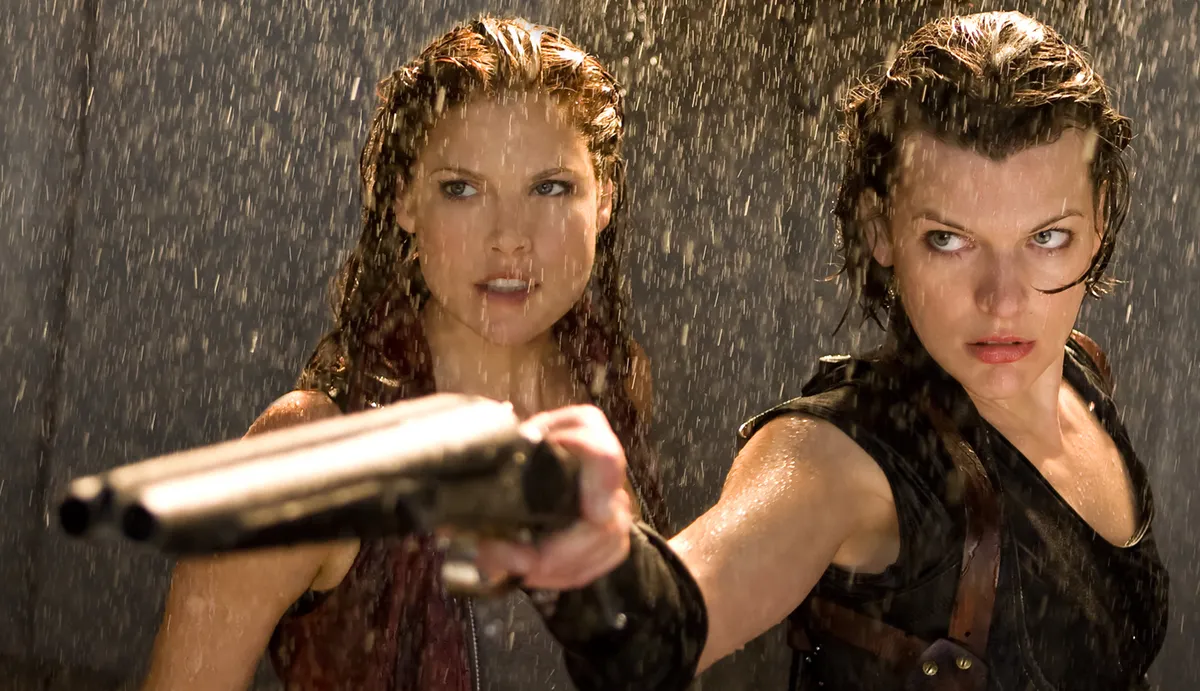
I'm not sure Resident Evil single-handedly kickstarted the zombie phenomenon back into life, but it was a decent zombie movie at a time when there weren't many of those around. Don't get me wrong: some of those Resident Evil films are terrible (Anderson directed the first entry, and then the fourth to sixth). But the original is underrated, and one of its smartest ideas was to act as a prequel to the games rather than re-telling their stories.
"It was originally titled Resident Evil Ground Zero," says Anderson, "because the third game had come out: Resident Evil Nemesis, right? And I thought this is kind of cool, it says 'Resident Evil' and then there's the title of that chapter.
"The way I'd always conceived of it is, every time a Resident Evil game came out it wasn't like Tomb Raider, where your lead was always Lara Croft. The games would have different characters in them. Same universe, but you'd have different characters and sometimes different locations as well. So I thought, well, the film should be like another iteration of the videogame, only this time we're going to be the prequel, and we're going to be Ground Zero. It's going to be the actual outbreak. How did it happen? Because I always found it fascinating.
"The first game you're in this mansion, it's very creepy and Gothic, and then underneath it you discover this high-tech laboratory where all these monsters are running around. But there's never really any explanation of how the monsters kind of started running around. What was the inciting incident that caused all this disaster? And I thought, well, for me as a videogamer, I would love to play that game, so I would love to see that movie.
"That kind of got around some narrative problems for me as well, which is I didn't want to just do a slavish adaptation of one of the videogames, because this was action horror, and in horror you can't give away all the secrets. If I did a straight adaptation of the first game, you'd already know if you're a fan going in Wesker is a traitor. This character is going to die here. This character is going to die there. Imagine watching Alien if, going into the cinema, someone told you they all die apart from Sigourney Weaver. That robs that movie of a lot of its power."
The movie would end up being shot in Canada for funding reasons, and in one of those weird coincidences Anderson was on the last flight out of New York on 9/11, and that incident was why Resident Evil would have to lose the subtitle.
"I'm going to Toronto to go scout locations, and I was flying through New York, and my flight was the last flight to leave New York airspace before New York airspace was closed down," recalls Anderson. "9/11 happened while I was in the air. So by the time I landed in Toronto I'd kind of missed it, but the event was obviously on every single screen in the airport as we landed.
"Then the whole shoot that I was scouting unravelled because American airspace was closed, no crew could travel, you know. So we ended up kind of delaying the whole thing for I think about a month. That's of course when Ground Zero, you know, we had to drop that as an idea, as a title. It just had resonance that wasn't appropriate anymore."
Finally, Anderson pushes back on the idea that it's weird for these films to have the political themes they do.
"Resident Evil has always traded in political themes," says Anderson. "And I think if people look at America now, corporate corruption, it has never been more evident. People are really going, 'Wow, these corporations, it's just scandalous that they don't pay any taxes and they manage to just weave around.' And Japan had gone through that 10 years before America, there was a lot of big scandals, political corruption, corporate corruption, and I felt when I played Resident Evil, that's what the Umbrella Corporation represented.
"It represented the fear of corporate corruption and the oppression that these corporations in hand with government bring, and the repression of the individual. And obviously zombie movies are at their heart the fear of loss of individuality. If you get bitten, you become one of the masses, you can't be individual. You're just one of the lumbering horde that don't get to think for themselves.
"So I think that those themes that became clearer and came to a culmination in the final chapter, they've always been in there in Resident Evil. And I think it's one of the reasons why the movies, above and beyond being great action, horror, entertainment and zombie films, I think it's why they struck a chord. I think they had a sophistication to them underneath the surface."
That may be going slightly further than I would, but I suppose you've got to allow the guy who actually made the films to puff them up a little. And I do think Anderson's work gets an unfair rap some of the time: it's not all grade-A gold, far from it, but Event Horizon is a classic and I still don't understand how he made a good film out of Monster Hunter. On the subject of critical perception, Anderson has a winning through-line.
"You know, I admired John Carpenter growing up: Halloween, The Fog, Assault On Precinct 13, Escape from New York, these were landmark movies for me," says Anderson. "Carpenter, who wrote and directed like I do, he very famously said, 'In America I'm a bum, but in France I'm an auteur.' And I do think [Europe] had an appreciation of him in a way.
"[There are] a lot of directors who were maybe marginalized or under-appreciated in the studio system because they were just churning out these movies, but they were John Ford, you know. I'm not saying that I'm John Ford, but the auteurs were working in Hollywood as well. And it doesn't have to be in a kind of snobby art movie: you can operate in other genres."
The full podcast episode has much more about Mortal Kombat, Resident Evil, and Paul W.S. Anderson's thoughts on all sorts of things. It is a great listen.

You must confirm your public display name before commenting
Please logout and then login again, you will then be prompted to enter your display name.