Join The Club





![Image for The White House is a radioactive crater in Fallout 3 because there were no quests there, so why build it? 'It is our version of [Indiana Jones] shooting the guy rather than pulling out his whip and going into a fight'](https://cdn.mos.cms.futurecdn.net/xJCYX8Qpr5B36aDxejzqsF-1280-80.jpg.webp)
Bethesda worthies have recently been on the interview circuit, reminiscing about all the good times when the studio was making Fallout games (note: it has been 11 years since a singleplayer Fallout game, and eight since the release of Fallout 76). Game Informer's excellent oral history of Fallout is one of the best, not least because we get to hear design lead Emil Pagliarulo recall that time he thought having an entire subway system under DC would be cool… until he realised endless underground tunnels were dull as hell.
One of the most interesting topics is the setting, with many at Bethesda delighted to work on a destroyed Washington DC because lots of them lived there. "It's cool to work in an area that you're deeply familiar with, because then you can include things that [other] people may not be familiar with, unless they live here," lead artist Istvan Pely told PCG recently.
Article continues below"Our team was small and a lot of architecture was built out of kits," says Pely. "You know, we had modular buildings and we could flesh out the world with office buildings and suburban buildings and stuff like that. But when it came to the iconic—like the Jefferson Memorial, the Capitol, and all that—those were unique pieces of art that would take an artist a while to make."
For studio head Todd Howard, what mattered was the setting having that basis in reality that allows the player to "reach and touch the world." Then the player "probably wants to go to a few places and see what they look like, but you still don’t know this world. If [the setting is] something that’s completely unknown, like, you don't know what you’re going to find at all, you have no pre-thought of that area, I don't think it works as well for a Fallout game, as opposed to, 'Oh, I can’t wait to see what this landmark looks like, or this landmark looks like!'"
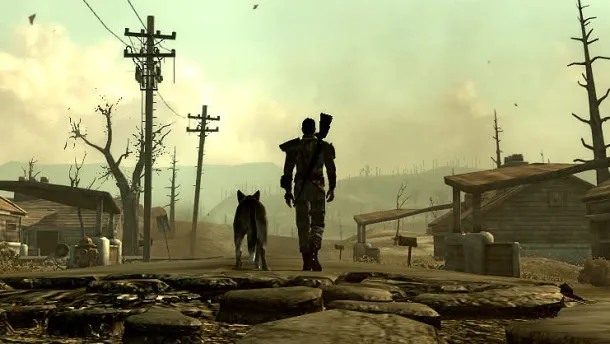
"There was no gameplay around the White House," says Pely. "Level design never said, 'Hey, we want to do this here,' so it was easy to overlook; usually if the designers don't request some assets to build out the [design], it doesn't get made. And then we're like, we can't ignore [the White House], so it was, like, 'Put a crater there. People will buy it.'
"Of course," laughs Pely, "it is our version of [Indiana Jones] shooting the guy rather than pulling out his whip and going into a fight."
I must confess, I always thought this was an awesome bit of world-building in Fallout 3 rather than a bit of a clever dodge. After all, the whole idea is that the world as we knew it got embroiled in a nuclear war that wiped out most of humanity: it just made sense to me that the White House was no longer standing, same way as I probably wouldn't expect to see the Kremlin survive.
There's plenty more across these various interviews, and in terms of how the sausage gets made I particularly enjoyed Todd Howard's recollection that the big inspiration for VATS was Burnout 2's Crash mode. And the fact that Bethesda thought people would enjoy the game ending in a full stop: "They hated it!"

You must confirm your public display name before commenting
Please logout and then login again, you will then be prompted to enter your display name.