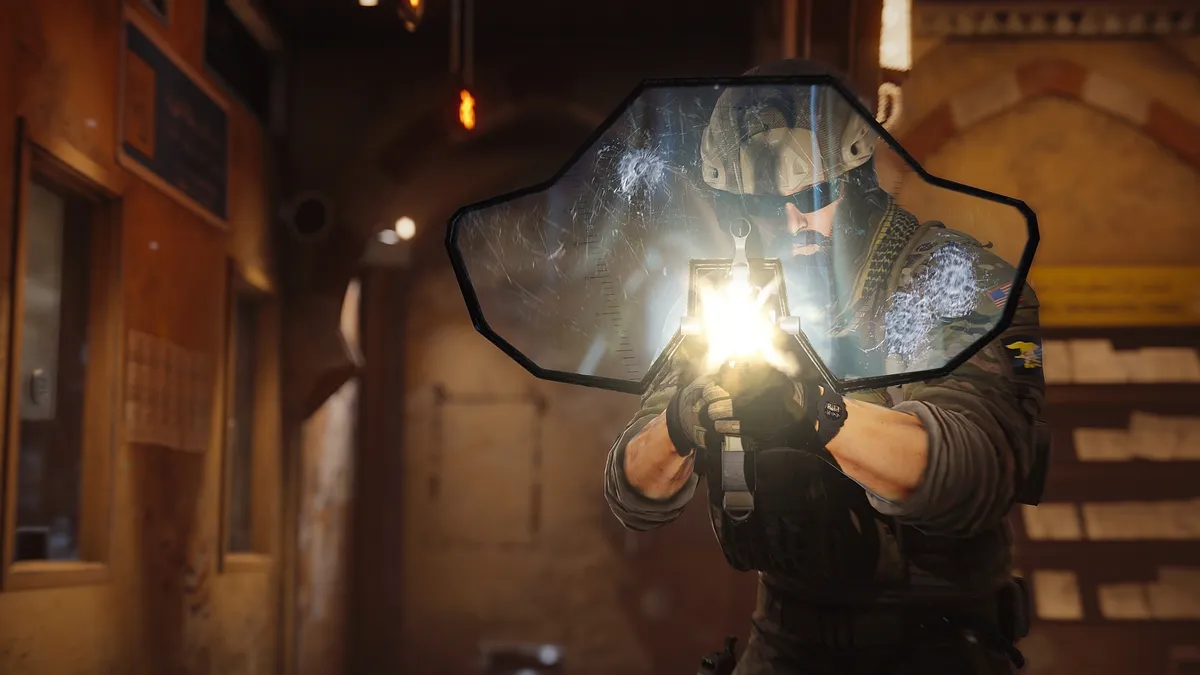
In Why I Love, PC Gamer writers pick an aspect of PC gaming that they love and write about why it's brilliant. Today, Shaun explains the appeal of silence in first-person shooters.
In Rainbow Six Siege you’re either the hunter or the hunted. As the latter, you’ve only got 30 seconds to prepare for the onslaught, which means figuring out where you are and what you need to protect, deciding which walls to barricade, barricading them, installing any special gadgets your operator carries, laying barbed wire or shields, learning your teammates’ intentions and then, once that’s all finished, waiting to be attacked.
So much time in Siege is spent waiting. It’s one of my favourite things about the game. During the tense moments before the attacking team is detected—you might hear their footsteps on the level above, or a distant breach—you must find safety. Safety is not abundant in any of Siege’s maps, and more often than not there’s a barricaded window, wall or ceiling in your line of sight that the enemy could breach at any moment. It’s possible to create relatively safe corners (you could barricade a wall and then use Mute’s scrabblers to neutralise Thermal’s special breach charges, for example) but they’re never failsafe. It’s possible to be less of a sitting duck as a defender in Siege, but you’re still a sitting duck.

That quiet moment after the mad rush of preparation, when everyone has established their positions and the attackers are on their way, is what makes Siege’s simulation so powerful. You can spend this time lining up your crosshairs on the most likely point of entry, or monitoring the CCTVs, but the awkward serenity—the silence—is still nerve-wracking. After all, in this game you can die (permanently) before you’ve even seen your murderer. Let down your guard, fail to keep stock of all possible attack points, and you’ll be punished.
The quiet is especially effective because, in 2016, there are virtually no other shooters that value silence or stillness. Indeed, most shooters do everything in their power to keep you shooting, to keep the music blaring, to serve up an impenetrable barrage of noise and excitement. Playing Overwatch at the weekend made me long for Rainbow Six Siege. Although I definitely want to get better at Overwatch, and although it feels good to win and learn, the emotions I experience are limited: I’m either exhilarated when I win, or annoyed when I lose. I’m never scared. I’m never stressed. I’m never curious or surprised. I’m never calm. Rainbow Six Siege makes me feel all of these things and more.
Waiting in Siege is all about listening. The ambience of the game’s varied locales is usually commonplace, banal. There might be a radio blaring glam rock in the far distance, or the echoed beeping of an airliner’s cockpit, or some other indistinct electronic hum. These enrich the anxiety of waiting, suffuse the world with a reality and drama that, in most other games, you have to decide to engage with.

In Siege, you need to untangle the ambience as you listen for telltale signs of your enemy’s strategy. It’s not just aural decoration: it can be an obstruction or a shield, but most strangely, it can be sad. These ambient sounds are subtle narrative dabs that make the maps feel like real locations that have been quickly and recklessly evacuated. Sprawling, story-driven RPGs barely ever achieve a mood as barren as Siege’s Los Angeles mansion, and are there any other multiplayer FPS games where the mood and theme of the maps are any more than window-dressing? I don’t think so, or at least, there have been none other that resonated with me.
After all this stressful waiting, something eventually happens. A wall is breached, a grenade is lobbed, and the cacophony of gunfire fills the room. This is stressful, of course—you’re getting shot at and will probably die soon!—but somehow it’s not as stressful as waiting. You almost welcome your attacker’s arrival, because it’s a huge release of pressure. They’ve found you, they’re pouring in from several directions, but at least you can fire that gun now, or set off that C4, or better still, wait like a trapped rodent in the corner, beneath an office desk, to catch them unaware.