


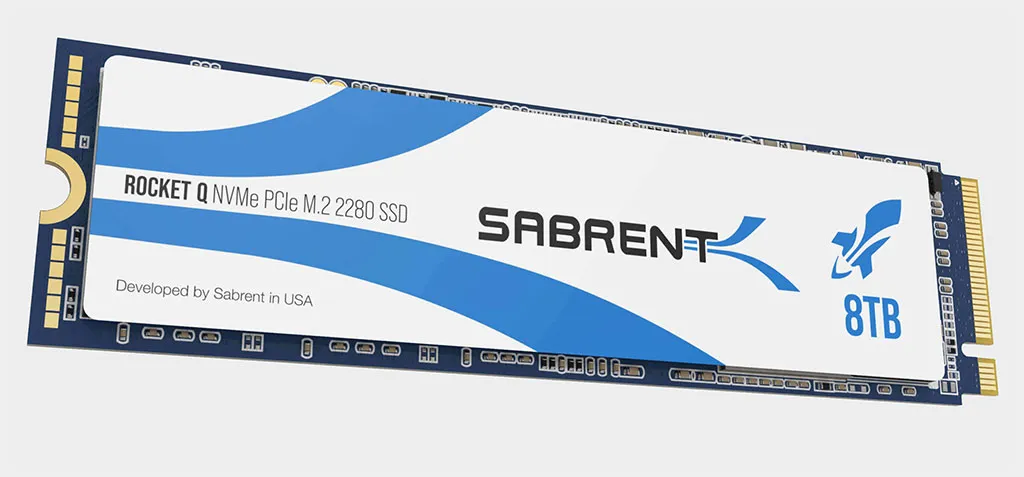
Sabrent is launching a massive 8TB M.2 solid state drive, and as far as ever-expanding Steam libraries go, it arrives not a moment too soon. It's just a shame that pricing will inevitably be sky high.
For those who can afford whatever Sabrent ends up charging for this thing, they will be getting the only 8TB M.2 SSD on the market. It's actually twice as capacious as the next biggest model. Granted, the same isn't true if venturing into 2.5-inch territory, but the M.2 form factor (shaped like a stick of gum) is sleeker and doesn't require any cabling.
It's also potentially faster, as is the case here. M.2 SSDs can be either SATA or NVMe, and this one falls into the latter category. The 8TB model joins Sabrent's Rocket Q family (via TomsHardware), which feature a PCIe 3.0 x4 interface.
Sabrent isn't providing many details about the 8TB model at the moment, but we can assume it's relatively fast, based on the rest of the Rocket Q family. Here's how things break down:
- Rocket Q 8TB SSD: TBD
- Rocket Q 4TB SSD: 3,400MB/s sequential read, 3,000MB/s sequential write
- Rocket Q 2TB SSD: 3,200MB/s sequential read, 3,000MB/s sequential write
- Rocket Q 1TB SSD: 3,200MB/s sequential read, 2,000MB/s sequential write
- Rocket Q 500GB SSD: 2,000MB/ sequential read, 1,000MB/ sequential write
As is often the case, the higher capacities are faster than the smaller drives, especially compared to the 500GB model.
The Rocket Q family uses QLC (quad-level cell) NAND flash memory paired with Sabrent's RKT 303 controller (TH reckons it's actually a rebadged Phison E12S controller). As our friends at Anandtech noted earlier this year, the mainstream SSD market is starting to shift from TLC (triple-level cell) to QLC NAND. This is what will lead to higher capacity SSDs, and I have no doubt other SSD makers will follow suit with 8TB models of their own relatively soon.
Pricing will need to come down even further on NAND flash memory as a whole, however, before these larger capacity M.2 drives become viable for the mainstream buyer. For example, the 4TB Rocket Q costs $749.99 on Newegg. For a gaming PC, it's just not worth it yet, let alone paying perhaps double that amount for an 8TB model.
The situation is better in 2.5-inch SATA territory, though they're still expensive—the cheapest on Newegg is Western Digital's Blue 4TB SSD for $519.99.
If looking to stretch your dollar, your best bet is still to go with a 500GB-2TB SSD, and pair it with an HDD if you need bulk storage.

