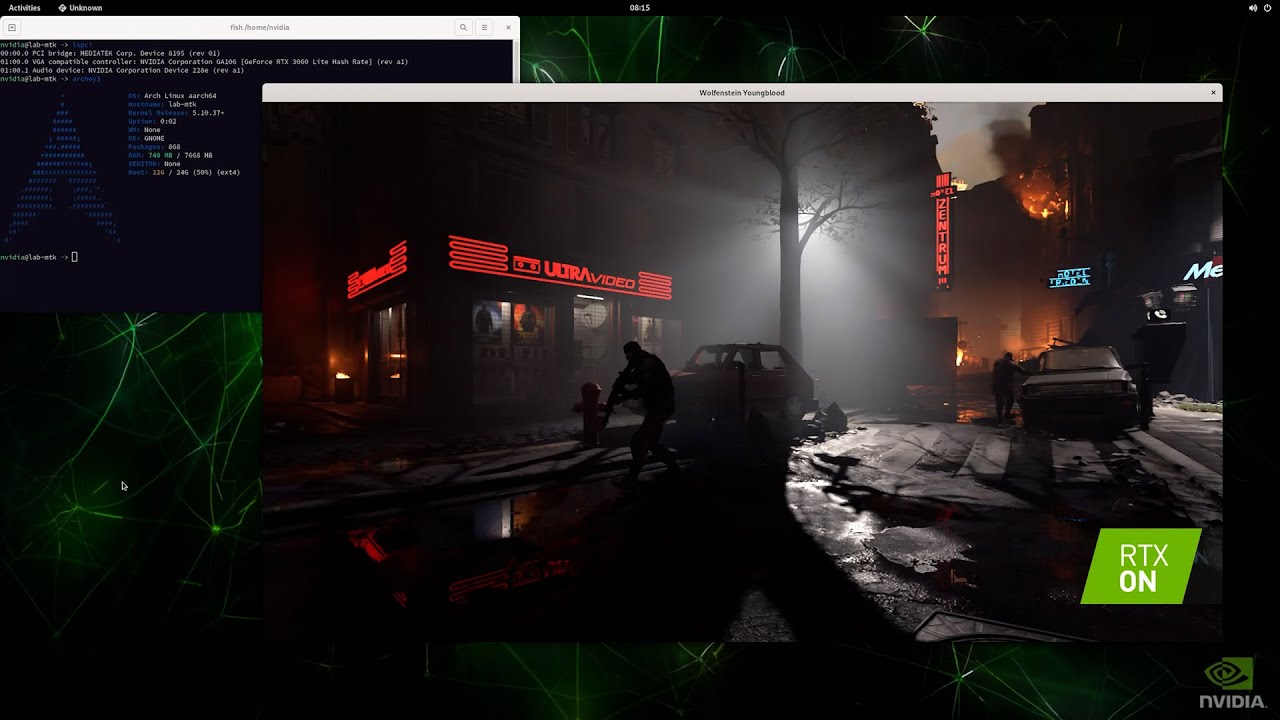
Nvidia is paving the way for entirely GeForce-powered notebooks, potentially shoving Microsoft, Intel, and AMD aside in its quest for high-performance gaming laptops. The green team has now proven the power of both ray tracing and DLSS running in a Linux distro, on ARM-based silicon, with RTX graphics cards plumbed into them.
And that should scare the crap out of everyone involved in the traditional Microsoft/x86 PC gaming monopoly.
So yeah, it sure looks like GDC 2021 is kicking off with a bang, as Nvidia has today shown Wolfenstein: Youngblood running with ray traced reflections enabled, and DLSS in operation, on a system using an eight-core MediaTek CPU and an Nvidia RTX 3060 GPU.
I would imagine this is an Arm-based gaming laptop because we've already heard talk of the two companies working together on a reference notebook spec after Nvidia's Graphics Technology Conference in April this year.
Back then Rick Tsai said that MediaTek looks forward "to using our technology and working with NVIDIA to bring the power of GPUs to the ARM PC platform for gaming, content creation and much more. GPU acceleration will be a huge boost for the entire ARM ecosystem."
And today we seem to have the fruits of that endeavour with Nvidia announcing, and showing off the fact that it has ported several key RTX SDKs for compatibility with Arm systems. These include:
- Deep Learning Super Sampling (DLSS), which uses AI to boost frame rates and generate beautiful, sharp images for games.
- RTX Direct Illumination (RTXDI), which lets developers add dynamic lighting to their gaming environments.
- NVIDIA Optix AI-Acceleration Denoiser (NRD), which uses AI to render high-fidelity images faster.
- RTX Memory Utility (RTXMU), which optimizes the way applications use graphics memory.
- RTX Global Illumination (RTXGI), which helps recreate the way light bounces around in real-world environments.
The DLSS and global illumination SDKs are coming soon, but the rest is ready and functioning in Arm with Linux and Chromium right now.

The MediaTek chip used in this demo is a high-end, big.LITTLE, eight-core MT8195 CPU, built on TSMC's N6 process (nominally 6nm), supporting LPDDR4x-4266. That means it's got four big ARM Cortex-A78 cores and four smaller ARM Cortex-A55 cores.
But doing the gaming good stuff is an Nvidia RTX 3060, most likely the laptop version which is a bit tastier than the desktop GPU of the same name.
"MediaTek and NVIDIA are laying the foundation for a new category of Arm-based high-performance PCs," says PC Tseng, GM of MediaTek.
This could be a huge thing for PC gaming, and will offer a whole new platform outside of the Windows and x86 hegemony that has existed for the longest time. Admittedly there are Arm preview versions of Windows 11 already out in the wild, sporting both emulation and native apps, but with this latest Nvidia RTX demo running on the Arch Linux distro, it shows that gaming laptops could soon have a very different heart, well away from the Microsoft, Intel, and AMD tradition.
And it could be huge for Nvidia too.

Best gaming PC: the top pre-built machines from the pros
Best gaming laptop: perfect notebooks for mobile gaming
If Nvidia's planned purchase of Arm is allowed to proceed—several parties are said to be intervening, not least the government of the United Kingdom where Arm is headquartered—then this could lead to fully Nvidia-based gaming laptops. I've already proposed the name ShieldBook, and you can have that one on me, Jen-Hsun.
"This is the first time real-time ray tracing and DLSS has been demonstrated on an Arm-based platform," Nvidia says of the demo. "The demos mark the latest milestone in a journey to bring advanced graphics to Arm-based systems. The potential is huge: billions of consumers rely on Arm-based devices every day. Realizing that potential will require a large technology and ecosystem building effort. It is one NVIDIA is uniquely positioned to advance."
But if the idea of Linux gaming gives you the chills, might I also point out that the new SteamOS 3.0 software, that will also run the new Steam Deck, has just had its base distro switched over from Debian to Arch.
So there's a very good chance we'll see an Nvidia Arm-based laptop in the future running on SteamOS from the get go. Maybe that means we'll also get a Steam Book.