Keep up to date with the most important stories and the best deals, as picked by the PC Gamer team.
You are now subscribed
Your newsletter sign-up was successful
Want to add more newsletters?
An account already exists for this email address, please log in.
Subscribe to our newsletter
Documents detailing technical aspects of what's thought to be its next-gen Zen 6 CPUs have been posted on AMD's website. The most significant covers AMD's adoption of Intel's so-called 'FRED' interrupt handling. It's a change that implies that Zen 6 could be a major architectural overhaul as opposed to a relatively minor revision.
FRED stands for Flexible Return and Event Delivery. At least, that's what it stands for now. No lesser an authority than Linux creator Linus Torvalds has something to say about that, more on which in a moment.
It's a replacement for the decades-old IDT or Interrupt Descriptor Table that dates way back to the Intel 286 processor circa 1982. Both FRED and IDT are instructions for how to handle system events, such as a mouse input or the arrival of a network data packet, also known as interrupts.
Article continues below
The technicalities are complicated. But to aggressively simplify the subject, with IDT, the smooth handling of these system events requires software developers to manually manage interrupts over several steps to minimise the risk of multiple interrupts conflicting with each other.
FRED ditches IDT's multiple manually-implemented instructions in favour of a single, optimised operation. The upshot should be fewer CPU cycles spent on event handling and potentially more performance.
Of course, the fact that FRED is an Intel technology ratified by the x86 Ecosystem Advisory Board and being adopted by AMD implies that the latter's CPUs won't be the only ones to enjoy any performance gains. That's probably true.
As it happens, Intel's new Panther Lake chip is its first CPU to support FRED. Panther Lake is certainly a very nice mobile CPU. But it doesn't bring really dramatic per-core CPU performance gains, albeit any uplift from FRED may not automatically be present in legacy software. In other words, the benefits of FRED may not be visible benchmarking existing software as opposed to code compiled explicitly to support FRED.
The biggest gaming news, reviews and hardware deals
Keep up to date with the most important stories and the best deals, as picked by the PC Gamer team.
Anywho, getting back to Mr. Torvalds, back in 2021, he opined quite positively on FRED. "The Intel FRED stuff has several years of background, and honestly, I think is the right thing to do. It really relegates the whole IDT to a 'we don't even use this at all, unless you have legacy segment selectors'. Good riddance to a truly horrid thing that goes back to a truly disgusting CPU architecture: the 80286," He said.
Come on, Linus, stop pulling your punches. In all seriousness, Torvalds also explained that AMD developed its own workaround for the shortcomings of IDT. Comparing the two approaches, he says, "Both are valid on their own, and they are actually fairly independent."
"FRED is very clearly defined to have an entirely new model, and any OS vendor that goes that way will still have to support the legacy exception model for older CPU's. The point being that the FRED exception handling is much simpler, but it's entirely separate code and logic, explicitly bolted to the side in the hope that the original code and logic can be removed entirely some day.
"In contrast, the AMD model is meant to very explicitly interface with existing code, and just allow people to avoid the fragile (and sometimes expensive) hacks and workarounds they already have. So they actually have very little overlap," he says.
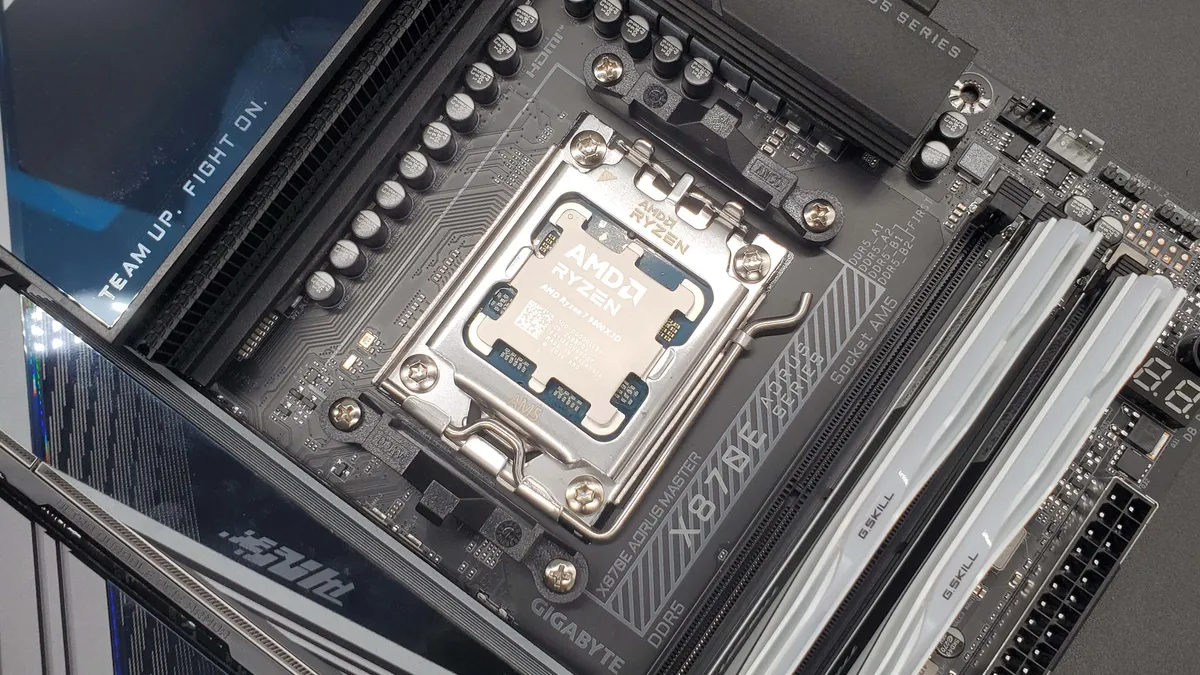
Could AMD's next-gen Zen 6 CPU architecture be a bigger update than it usually delivers for even numbered Zen generations? (Image credit: Future)
Torvalds then concludes, "I think the Intel version is better if you think that x86-64 should actually survive longer-term, and you actually want to improve exception handling and speed things up (the 'F' historically stood for 'Fast', I'm not sure why they've apparently renamed it 'Flexible')," all of which provides intriguing insight.
Now, arguably, the idea that Zen 6 will be a major architectural step doesn't entirely align with previous generations of Zen CPUs. AMD has thus far tended to restrict major redesigns of Zen to every other architecture. Zen 1, Zen 3 and Zen 5 are the fully or substantially new architectures by that narrative, with Zen 2 and Zen 4 more minor updates. On that schedule, Zen 7 would be the next big redesign.
Still, not only is that characterisation of AMD's Zen architectures open to interpretation, it's no guarantee that AMD hasn't gone for a bigger upgrade than usual for an even-numbered Zen generation. Whatever, we should find out more later this year when AMD is expected to release its next-gen Zen 6-based processors.
Jeremy has been writing about technology and PCs since the 90nm Netburst era (Google it!) and enjoys nothing more than a serious dissertation on the finer points of monitor input lag and overshoot followed by a forensic examination of advanced lithography. Or maybe he just likes machines that go “ping!” He also has a thing for tennis and cars.
You must confirm your public display name before commenting
Please logout and then login again, you will then be prompted to enter your display name.