Join The Club





Both Samsung and LG, the two big makers of OLED screens that go into TVs and monitors, announced new panel technology at CES 2026 with 4,500 nits of peak brightness. Question, will that tech appear in a PC monitor any time soon?
The answer is yes and no. Yes, the technologies seen in the new panels are headed for PC monitors. But, no, you can't expect to see PC monitors anything like that bright.
Article continues below 
As for LG, it announced its latest Tandem WOLED tech at CES, also topping out at 4,500 for peak HDR brightness, though it didn't indicate full-screen brightness performance.
It's currently not entirely clear what the specs will be for this technology when translated to PC monitors. LG has also announced a slew of new OLED monitors at CES, branded UltraGear Evo. But not only is it not entirely clear how they relate to the TV panel generation announced at CES, for now LG is only saying that they are VESA DisplayHDR True Black 500 certified.
That standard requires full-screen brightness of 300 nits, something which the very latest LG monitor panels already achieve. My understanding is that peak HDR brightness for the new generation will edge up to 1,500 nits. Full-screen will probably be in the region of 350 nits.
Where things get complicated with LG panels concerns its new RGB-stripe panels. Those screens removed the white subpixel and so actually offer lower peak brightness ratings. Again, we don't yet know how extensively LG is going to apply RGB-stripe tech to its monitor offerings. But for now it's just a single 27-inch 4K panel model.
But speaking of monitor panels, why exactly are they so much dimmer than their TV equivalents? There are several known reasons, known knowns in Rumsfeldian terms, and likely some unspoken known unknowns that may become better understood over time, and then possibly some unknown unknowns that we'll never learn about.

In the first category, there's pixel density. When it comes to the larger panels that go into TVs and monitors, as opposed to OLED panels in phones and laptops, which are a completely different species, smaller pixels are dimmer pixels. And PC monitors generally have much smaller pixels than TVs.
Next up up is use case. PC monitor are far more likely to be called on to display static content, like the Windows taskbar, for instance. And static content is more problematic when it comes to burn-in. So, PC monitors are calibrated more conservatively to prevent burn in.

Catch up with CES 2026: We're on the ground in sunny Las Vegas covering all the latest announcements from some of the biggest names in tech, including Nvidia, AMD, Intel, Asus, Razer, MSI and more.
Falling into the known unknowns category is how TV and monitor panel techs compare, generationally and in terms of technology. The two panel classes don't map perfectly to each other. A recent example is the new RGB-stripe tech which is monitor specific. But long story short, there are technical differences between the panel types that explain some of the brightness gap, even if it's not always obvious what they are.
Beyond all that, the gap between 4,500 nits for the brightest TVs and 1,500 nits for the brightest monitors is still absolutely huge and, personally, I'm not totally sure why that's the case, even taking into account all the known knowns and known unknowns. Perhaps one day, we'll find out.
In the meantime, there are still some really exciting looking new OLED monitors at CES. As for which is the most exciting, that's a subject for a separate story. But here's a hint. It's one of those new LG UltraGear Evo models.
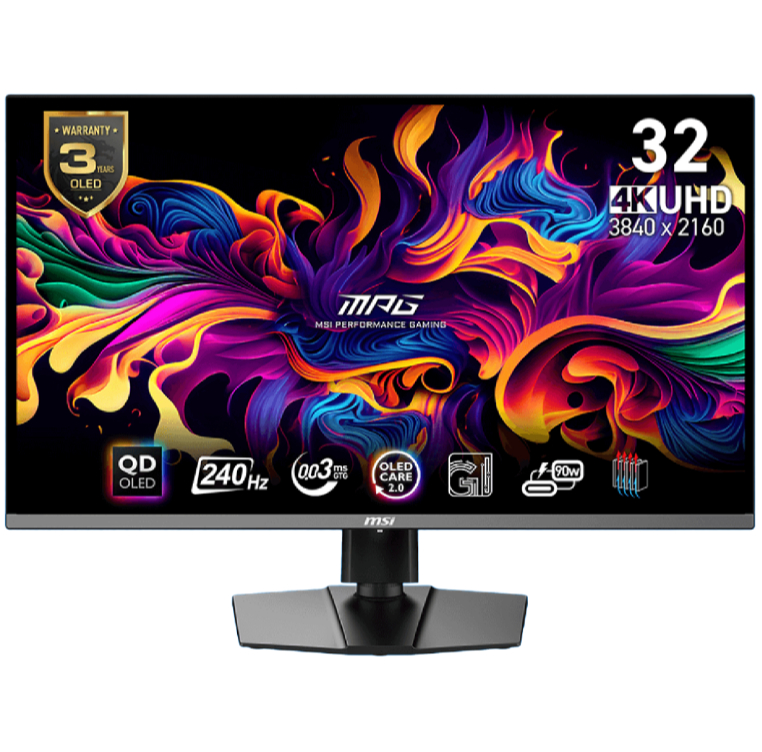
1. Best overall / 4K:
MSI MPG 321URX
2. Best budget 4K:
Asus ROG Strix XG27UCG
3. Best 1440p:
MSI MPG 271QRX
4. Best budget 1440p:
KTC H27T22C-3
5. Best 1080p:
AOC Gaming C27G4ZXE
6. Best Ultrawide:
Gigabyte MO34WQC2
7. Best budget ultrawide:
Xiaomi G34WQi
8. Best 32:9:
Samsung Odyssey OLED G9
9. Best dual-mode:
Alienware AW2725QF

You must confirm your public display name before commenting
Please logout and then login again, you will then be prompted to enter your display name.