





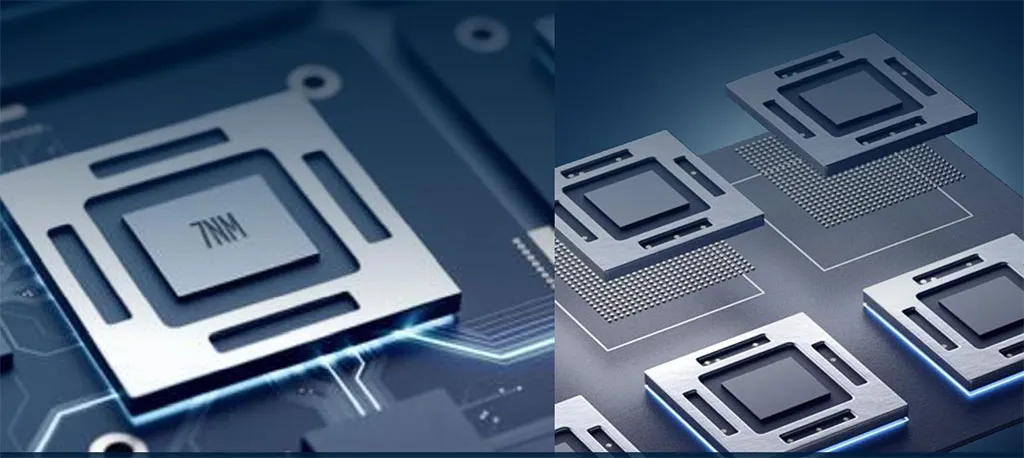
Over the weekend, Intel unveiled a new GPU architecture called Ponte Vecchio for high performance computing (HPC) and artificial intelligence (AI) workloads. That means it's bound for the data center and not home computers, though it falls under the same Xe umbrella that Intel's discrete gaming GPUs will also occupy.
I'm not taking a deep dive into Ponte Vecchio, because as a data center GPU, it falls out of the purview of PC gaming (our friends at TomsHardware posted a more detailed examination of the architecture, for those who are interested). However, there are some notable bits I wanted to pass along.
One is that Ponte Vecchio is being built on a 7-nanometer manufacturing process. Intel's struggles getting to 10nm for its CPUs have been well documented, and even today, we're still waiting for 10nm desktop CPUs to arrive (the only 10nm parts to arrive in volume from Intel so far has been been its Ice Lake lineup for ultraportable laptops).
"Ponte Vecchio will be manufactured on Intel's 7nm technology and will be Intel's first Xe-based GPU optimized for HPC and AI workloads. Ponte Vecchio will leverage Intel's Foveros 3D and EMIB packaging innovations and feature multiple technologies in-package, including high-bandwidth memory, Compute Express Link interconnect, and other intellectual property," Intel said.
It's a fairly advanced GPU architecture, in other words. Foveros, as you may recall from our coverage last December, is a 3D chip packaging technology Intel introduced at the time. What makes Intel's implementation unique to other 3D stacking technologies is that it applies to logic chips, which enables logic-on-logic integration for the first time.

The other thing that's interesting here is how Intel is categorizing its discrete GPUs. During a keynote speech on Sunday, Intel's graphics boss Raja Koduri said that Intel will have a single Xe architecture encompassing many different product segments, under which there will be various sub-architectures, as reported by our friends at AnandTech.
In that sense, Ponte Vecchio will inevitably share some characteristics with whatever discrete gaming GPU Intel ultimately unveils. It's impossible to know at this stage how much DNA to the two will share, but 3D chip stacking is certainly a possibility.
This approach also gives Intel a bit of flexibility in fine tuning different GPUs for different markets. Rather than release what amounts to a single GPU for different markets with certain parts enabled or disabled, it looks as though Intel will base unique designs for different markets on a general architecture (Xe).
Ponte Vecchio will make its debut in the Aurora supercomputer at Argonne National Laboratory in 2021. Intel's first discrete Xe GPU is still scheduled to come out in 2020, but it's anyone's guess if it will be for gaming, servers, or something else. Either way, this is not the year to expect any Black Friday deals on Intel GPUs.

