Join The Club





A couple of months ago Logitech unveiled quite the surprise for the competitive PC gaming scene with the G Pro X2 Superstrike. It's the first gaming mouse to feature proper analogue switches under the left and right mouse buttons, meaning it's the first to offer clicks that respond to the slightest touch, or whatever level of force you set it to.
As soon as I got my hands on the Superstrike—first at Logitech HQ in Switzerland where I got to see everything that went into making it, and then at home for some more extended testing—I knew it wasn't just a gimmick. At least for some kinds of competitive gamer, the improvement on offer is real, as it cuts down the time between starting to press and having your click register and your in-game weapon fire (for instance).
Article continues belowSpecs comparison
| Row 0 - Cell 0 | Viper V4 Pro | Superstrike |
Buttons | 5 | 5 |
Connectivity | USB-C wired / 2.4 GHz wireless | USB-C wired Lightspeed wireless 2.4 GHz / PowerPlay |
Sensor | Focus Pro 50K optical (Gen 3) | Hero 2 |
Switches | Gen 4 optical | Haptic Inductive Trigger System (HITS) |
Feet | PTFE | UHMWPE |
Max DPI | 50,000 | 44,000 |
Weight | 49 g (black) / 50 g (white) | 59–61 g (depending on puck) |
Max acceleration | 90 G | 88 G |
Max speed | 930 IPS | 888 IPS |
Polling rate | Up to 8K | Up to 8K |
Battery life | 180 hours @ 1,000 Hz | 90 hours @ 1,000 Hz |
RGB lighting | No | No |
Included extras | Dongle, cable, grip tape, stickers | Dongle and extender, cable, grip stickers, puck with skates, cleaning cloth |
Price |
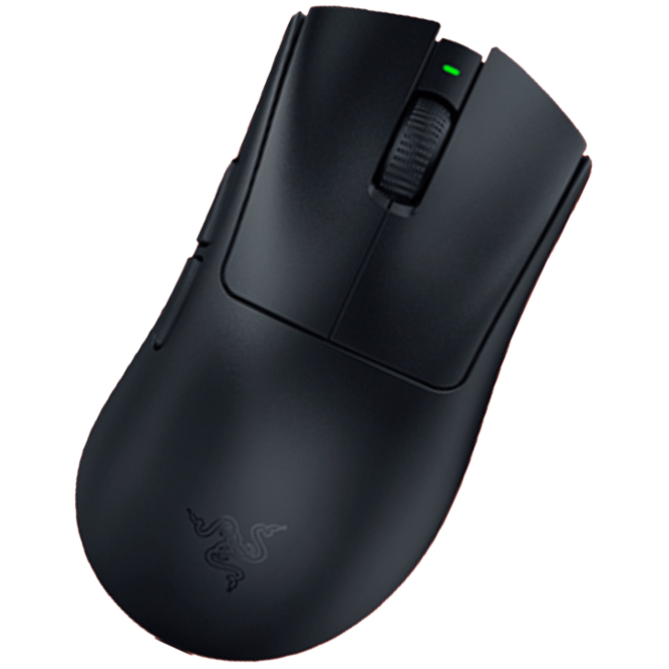
Setting aside the apples-to-oranges switch comparison for the time being, you're clearly getting a better all-round package with the Viper V4 Pro. That would be true even if it was the same price as the Superstrike, but it's actually cheaper—in the US, at least.
The long and short of it is that you're getting a lighter mouse with double the battery life and a more performant sensor. You're also getting a better, more bulbous dongle that actually stays put on your desk and has some useful LEDs.
Some of you might also be interested to know that the Viper has an optical scroll wheel, while the Superstrike has the same mechanical scroll wheel as in the previous Logitech G Pro X Superlight 2. The latter wheel is known to sometimes develop scrolling issues and in my own testing suffers from problems with long-presses. The optical wheel on the Viper V4 Pro, at least in theory, shouldn't be as likely to develop problems because there's less mechanically that can go wrong.
Overall quality

Specs aren't the only place where the Viper V4 Pro comes out in front. It's also a much more premium-feeling mouse. In fact, it's the most premium-feeling mouse I've had my mitts on, and I've tried quite a few.
Both have nice, safe shapes that should suit a variety of grips. The Superstrike's G Pro/Superlight style 'potato' shape has a bit more of an extended hump that pushes into your palm more towards the back, but the two symmetrical shapes are generally quite similar.
The Viper V4 Pro feels a step above the Superstrike, though, thanks to its near-flawless build quality. And while the Superstrike doesn't feel cheap, it's far from perfect.
The Viper's buttons are very tactile and have practically zero pre-travel, there's not an ounce of mushiness to the scroll wheel, and the skates are nice and smooth. The Superstrike, on the other hand, has mushy side buttons, pretty slow UPE skates, and a mediocre scroll wheel that doesn't play well with long presses. There's also quite a bit of left-right wobble to the left mouse button, on my model at least, after bottoming out the button press.
The icing on top for the Viper when it comes to the general experience, in addition to the battery life, is the fact that you can change all your settings on Synapse Web. So, unlike with the Superstrike, you don't have to keep a local program installed to change your mouse settings.
Are the speedy clicks worth it?

After spending a lot of time using both mice, I can say confidently that the Superstrike is a boon to games like Counter-Strike and Valorant but not much of a boon to other games such as Overwatch, Apex Legends, and so on. Its clicks are worth it if you primarily play tactical shooters that have a low time-to-kill (TTK) and rely on quick reactions. I suppose games that require a high number of clicks per minute (CPM) will benefit, too, but that's far outside of my wheelhouse.
In games like CS2, a lot of your time is spent holding angles or peeking around them, hopefully with your crosshair placed very close to where your enemy's head should appear. In these situations, saving a few milliseconds between spotting that head and having your mouse click register can make a difference. Anyone who has played CS2 or Valorant seriously will be familiar with the post-death certainty that 'if I'd just shot a split second sooner, I'd be the one alive right now and my team would have won the round.'
You don't get those feelings quite so often or to quite the same extent in other kinds of competitive shooter. Playing Overwatch, for instance—even when playing as Cassidy—I don't feel that need for split-second click reaction to anywhere near the same extent as I do in CS2. And if I'm playing a tracking-heavy game like Quake Champions or Apex Legends, I don't feel the need at all.

However, just note that even in the games where it is of benefit, the Superstrike's clicks don't give a night and day difference and they certainly won't greatly improve your overall headshot percentage or kill:death ratio.
I started doing some daily tests comparing my scores with the different mice in CS2 and in aim trainers, but I quickly noticed there was no difference. What makes the most difference by far is a combination of overall reaction time and aim. The time it takes your finger to press down is just one tiny part of that.
One big caveat to both the Viper and Superstrike is that, as many an enthusiast is prone to say, shape is king when it comes to gaming mice. If you don't get on with the Superstrike's or the Viper Pro's shape, you're probably better off getting a different mouse entirely.
Better off, that is, both in general and also regarding competitive performance, because it's hard to perform well with a mouse you don't enjoy holding. I, for instance, am currently debating long and hard over whether to ditch the Superstrike for the Zowie EC2-DW, which just fits in my grip so snugly.
Niches on niches

The shortened answer to the question of which mouse to get is as follows:
First and foremost, get a mouse with a shape that suits your grip. If the Viper V4 Pro and Superstrike fit the bill, then get the Superstrike if you (A) play primarily tactical shooters with low TTK and (B) are happy spending $180 for a slight potential advantage over all other mice. If you don't fit those two criteria, get the Viper V4 Pro, and bask in its near-flawless quality.
The Razer Viper V4 Pro has brought me back to earth a little. Initially I got a little swept up in the Superstrike's new and impressive analogue click technology, and while my opinion hasn't changed on how much of a game-changer it is, the Viper has reminded me just how nice it can be to have every other aspect of a mouse be almost perfect.
For the tactical shooter niche inside the broader competitive niche, the Superstrike beats it for in-game performance, provided you like its shape and are fine sacrificing some broader quality and feel. But for everything else the Viper V4 Pro comes out on top.
1. Best wireless:
Razer DeathAdder V4 Pro
2. Best wired:
Logitech G502 X
3. Best budget wireless:
Logitech G305 Lightspeed
4. Best budget wired:
Glorious Model O Eternal
5. Best competitive:
Logitech G Pro X2 Superstrike
6. Best lightweight:
Corsair Sabre V2 Pro
7. Best MMO:
Corsair Scimitar Elite Wireless SE
8. Best compact:
Razer Cobra Pro
9. Best ambidextrous:
Logitech G Pro
10. Best ergonomic:
Keychron M5
11. Best customizable:
Orbital Pathfinder

You must confirm your public display name before commenting
Please logout and then login again, you will then be prompted to enter your display name.