





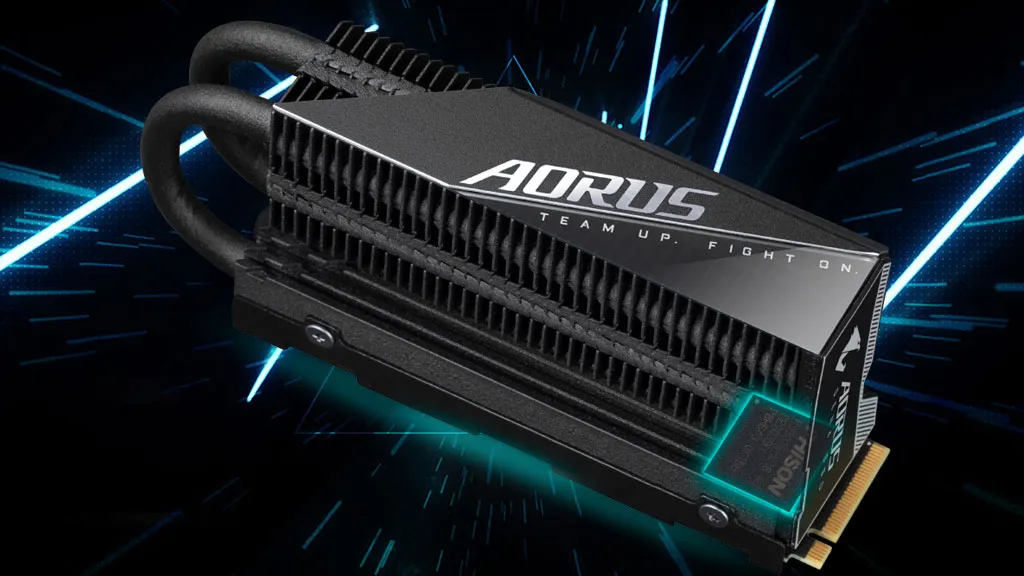
When it comes to PC components heat is generally the enemy, hence why frequency and performance benchmark records typically entail liquid nitrogen (LN2) cooling. We're not there yet for SSDs, though Gigabyte did slap a set of heat pipes and a chunky cooler on its latest offering, the Aorus Gen4 7000s Premium, and says it will never throttle.
Best SSD for gaming: the best solid state drives around
Best PCIe 4.0 SSD for gaming: the next gen has landed
The best NVMe SSD: this slivers of SSD goodness
Best external hard drives: expand your horizons
Best external SSDs: plug in upgrades for gaming laptops and consoles
Or maybe the promise is it will resist slowing down much longer than most SSDs. Gigabyte's exact wording is that it delivers up to a "7GB/s read speed while optimizing passive thermal dissipation, which promises no throttling under long-lasting operation."
How long, exactly? Well, on the drive's product page, Gigabyte posted a graph showing it running at full speed for over eight hours. The fine print, however, also notes that "actual performance may vary under different circumstances."
In any event, the heat pipes have a nano-carbon coating and rope through a multi-layered heat sink, with stacked fins and dual-sided thermal pads assisting in the effort. There's also an aluminum base-plate that sits on the underside of the SSD.
We have not tested this drive yet, but we'll be curious to see how it fares outside of Gigabyte's lab, both with and without proper airflow.
"Even without airflow, the thermal solution is capable of preventing the thermal throttling that might occur at high-speed operation," Gigabyte's Jackson Hsu said in a statement.
The drive leverages Phison's new eight-channel E18 controller, which directs the 3D triple-level cell (TLC) NAND flash memory chips and single-level cell (SLC) cache. There are two capacities being offered, each with the same rated sequential read performance:
- 2TB—7,000MB/s seq. read, 6,850MB/s seq. write, 650K random read, 700K random write
- 1TB—7,000MB/s seq. read, 5,000MB/s seq. write, 350K random read, 700K random write
Of course, you'll need a platform that supports PCIe 4.0 to take full advantage of the speed capabilities. AMD's X570 and B550 chipsets do, and same goes for Intel's Z590 and B560 chipsets for Rocket Lake (some Z490 and H470 boards do as well, with a BIOS update). You could still run a PCIe 4.0 SSD in a PCIe 3.0 motherboard, just the read and write speeds will be slower than advertised.
The drives are supposedly "already in the market," though we couldn't find any listings at places like Amazon and Newegg. We expect they will show up soon. There's no info on pricing, but as a point of reference, the non-premium version with a lower profile heat sink runs $380 for 2TB and $200 for 1TB (both sale prices at Amazon).

