


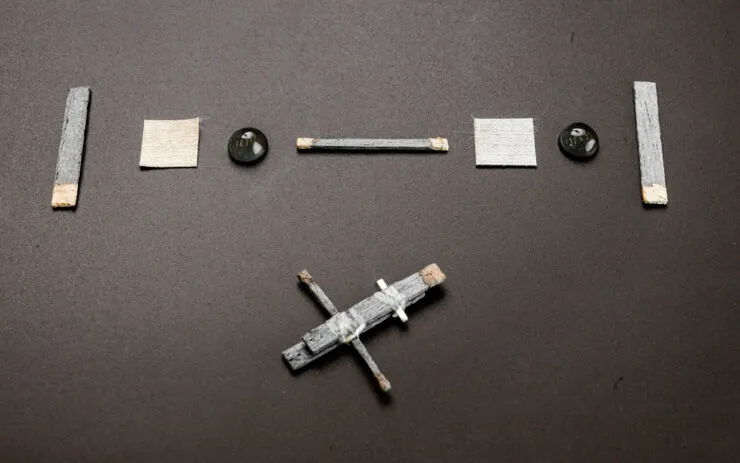
Transistors are one of the major building blocks of modern electronic devices. They allow us to regulate current in electronics which makes most of what we do regarding tech, including PC gaming possible. As tech moves forward we see these little miracles get even smaller, with large fabrication facilities already prepping for newer, tinier transistor manufacturing. But it turns out making transistors smaller and made out of silicon isn't the only way, we could also be making them much larger and out of wood.
Tom's Hardware reports researchers at Linköping University in Norrköping, and the Royal Institute of Technology in Stockholm, have managed to develop an early version of a wood electrochemical transistor (WECT) that appears to be the first of its kind ever logged. Though these wood chips are quite different to the silicon ones we're used to reporting on here.
Balsa wood is the current lumber of choice for WECT fabrication thanks to its consistent structure. It then goes through a chemical process to remove the lignin, which are organic polymers in the wood. They're replaced by PEDOT:PSS, a highly efficient organic conductive polymer to make the wood conductive. Whether this stops them being truly wooden transistors has me a bit stumped.
Much like the Ents, WECT are far larger and slower than their silicon hobbit-sized counterparts. Rather than being measured in nanometres and gigahertz, these transistors are on the centimetre and regular hertz scale. With a 3cm transistor with a switching frequency of under one hertz, these are transistors even Treebeard would be proud of.

Best gaming mouse: the top rodents for gaming
Best gaming keyboard: your PC's best friend...
Best gaming headset: don't ignore in-game audio
“We’ve come up with an unprecedented principle. Yes, the wood transistor is slow and bulky, but it does work, and has huge development potential,” says Isak Engquist, senior associate professor at the Laboratory for Organic Electronics at Linköping University.
Creating the WECT isn't about trying to achieve speed and power, it's for seeing if and how something like this could be done in the first place. It has the potential to help us produce transistors out of commonly found biodegradable material. The larger transistor may lend itself to holding higher current, and the understanding of electronics and wood may even provide a path to directly controlling plants further down the line. But for right now, its bark is stronger than its byte.
“We didn’t create the wood transistor with any specific application in mind. We did it because we could. This is basic research, showing that it’s possible, and we hope it will inspire further research that can lead to applications in the future,” says Isak Engquist.

