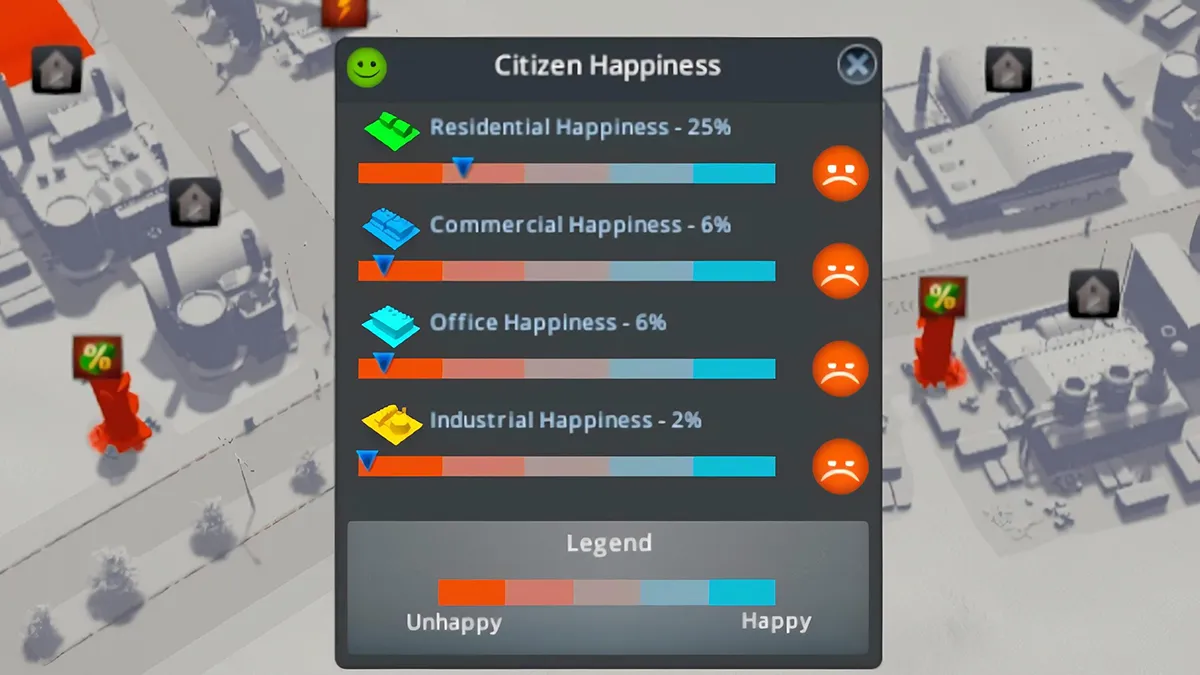
Videogames are filled with meters. You can have meters for health, stamina, magic, hunger, thirst, XP, even sanity. And in some games, meters can show how other people are feeling, too. In Guitar Hero, the rock meter tells you how stoked your audience is, in Frostpunk a meter shows your survivors' hope and discontent, and In Cities: Skylines, meters display citizen happiness (and unhappiness) across your growing metropolis.
So, it feels like the most videogame thing ever that mathematicians at the University of Vermont have been developing a happiness meter for the real world.
It's called the "hedonometer" and it analyzes word usage on Twitter in an attempt to determine the global temperature of people's feelings. "Our Hedonometer is based on people's online expressions, capitalizing on data-rich social media, and we're measuring how people present themselves to the outside world," states the hedonometer website. "For our first version of hedonometer.org, we're using Twitter as a source but in principle we can expand to any data source in any language."
A short thread on what we’ve measured in the last 5 days, from Election day through to yesterday, when Biden was projected to become president-elect. pic.twitter.com/ifhvWVpgUSNovember 8, 2020
Here's roughly how it works. A "happiness score" of 1-9 (1 being saddest and 9 being happiest) is assigned to "the 5,000 most frequent words" gathered from sources like Google Books, New York Times articles, Twitter, and song lyrics. Then the global output from Twitter is collected an analyzed.
"The stream reflects a 10% random sampling of the roughly 500 million messages posted to [Twitter] daily, comprising roughly 100GB of raw JSON each day. Words in messages we determine to be written in English are thrown into a large bag containing roughly 200 million words per day. This bag is then assigned a happiness score based on the average happiness score of the words contained within."
I have a few immediate concerns about this happiness meter. First, like Twitter itself, it's extremely US-centric, and figuring out how Americans feel about things isn't (to my mind) some sort of elaborate mystery. We never shut up. Also, the simple act of looking at Twitter immediately makes me unhappy and thus makes me more likely to type unhappy words into it. If the tool being used to collect something for measurement has an effect on what's being measured, it doesn't sound like a great tool. It's like drinking fresh spring water from a rusty bucket and wondering why it tastes like metal.
There are, however, some interesting facets to examining word usage and determining if a word is happy or sad. On Gimlet's Reply All podcast, host Alex Goldman spoke to one of the hedonometer's creators, computer scientist and mathematician Peter Dodds, who mentioned how the usage of certain words can change over time and need to be adjusted (or removed) from the data. "Thirsty," for example, is a word that until recently would imply some measure of unhappiness, because needing a drink and not having one isn't a pleasant feeling. But when people began using thirsty to mean "horny" on Twitter, it just "overwhelmed" the hedonometer system. "Okay, we're retiring that word," Dodds said.
Anyway, I suspect some of the happiest people in the world are people who don't use Twitter at all, and thus their happiness (buffed at not constantly bathing in everyone else's word-garbage all day) is not being captured by the hedonometer at all. I mean, just imagine not ever using Twitter. It must be glorious.