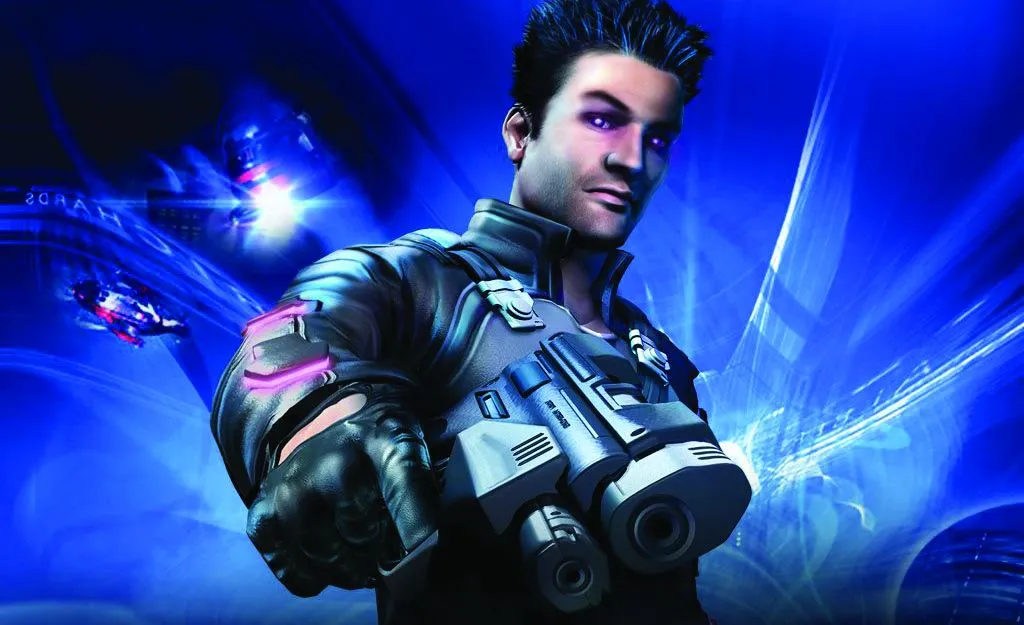
Deus Ex: Invisible War has its defenders, including PC Gamer's own Joshua Wolens, but even the most stout-hearted of them would never go as far as saying it was a worthy sequel to the original. Where Deus Ex ripped up the rulebook and set an example that the immsim genre has struggled to replicate ever since, Invisible War was a much more trammelled game that, for all the good ideas, felt less expansive and ambitious.
Is it a decent game? I'd say yes. Is it the Deus Ex 2 we should've had? Not in a million years. Sorry Josh.
"The truth is, no," says Smith. "We finished Deus Ex and everyone loved it, and we just thought, 'Well, the games we want to make are the right kinds of games'. And then you go and do something else, and you fall flat on your face.”
The issues began in 2001 when there was a top-down decision that Ion Storm Austin’s two in-development games should use the same engine. The games were Invisible War and Thief: Deadly Shadows, and the idea was that team members could more easily transition between projects that were built on the same tech. Only problem was, they didn't have the actual tech.

"I wish we could redo that project and just stitch the maps together," says Smith. "You get to a room, there’s a load. Another room, another load. It hurt the game. It sucked."
Added to which, Eidos had suddenly started paying a lot more attention to Deus Ex after the original's sales, and was pushing for one change in particular that would cause enormous controversy.
"Eidos had some weird theories like 'FPS games don’t sell' or 'RPGs don’t sell'," says Smith. "And I was like, 'Are you kidding?' But people have their opinions and they’re trying to lead their companies, and if you have a mortgage and have a job, sometimes you have to do what the boss says. So, there was pressure from Eidos for it to be a console game."
So: blame Xbox. Microsoft’s console became the target platform, alongside PC, but obviously had a fixed spec and couldn't compete with the high-end gaming PCs of the day. All of which meant that the existing problems with the new engine were exacerbated even further.
"You go to console and you have a lot fewer systems for memory," says Smith. "You need to develop for the baseline console. You can’t assume people are going to be able to upgrade, or be on the bleeding edge.
“But there were legit complaints," he continues. "As we adapted Invisible War to console with the map sizes, the UI and everything, we walked into this kind of buggy, inelegantly-made-for-console game. It angered our most hardcore followers."
Ultimately, Invisible War's final form came down to these background problems rather than the team's ideas for the sequel: they just couldn't make the game they wanted to make. And for Harvey Smith in particular it was a painful time, though with hindsight he says his regrets are more about decisions he made as project director, rather than the final product.
"It was very painful to go from Deus Ex, where everyone was lauding us, to Invisible War, where I felt like I’d done a bad job," Smith says. "Disappointing the fans hurt. People not liking the game as much hurt. Acknowledging that I had made mistakes hurt. It was painful. For me, hypersensitive to criticism at the time, it felt brutal."
But painful as the fallout was, there would ultimately be a silver lining for the genre. Dissatisfied with Eidos and its management of Ion Storm Austin, Smith and Bare both left the company in 2004, alongside other senior staff like Warren Spector, and it was shut down a year later. Smith and Bare have subsequently maintained a long-lasting collaborative relationship, working on some of the best immersive sims ever made like Dishonored, Dishonored 2, and Prey.

You must confirm your public display name before commenting
Please logout and then login again, you will then be prompted to enter your display name.