Join The Club





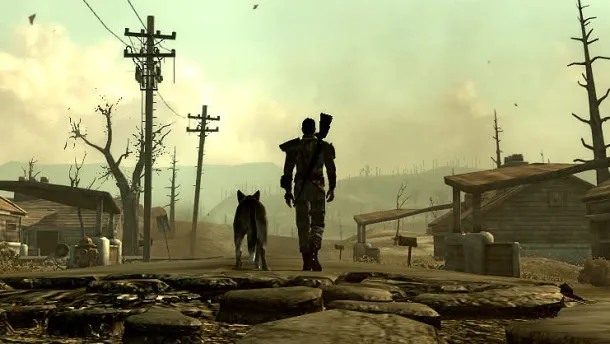
The latest issue of Edge magazine features an article on the making of Fallout 3, including interviews with some of Bethesda's key creatives tasked with bringing the classic isometric series into 3D. Fallout itself "was a big pivot" for a studio best-known for the fantasy world of the Elder Scrolls, says lead artist Istvan Pely, and meant the studio "had to prove that we could pull off a totally different genre, the opposite of fantasy."
Pely was responsible for much of the game's look, and he began by going back to the source. "It started with the box art," recalls Pely. "The original Fallout 1 box, with the power armour on it, was iconic. To me, that was Fallout. So, that was the first thing, the first asset. The next iconic thing was the Pip-Boy. It's kind of an abstracted thing in the early games. But we wanted it to be an actual, physical device that you wear on your wrist. Then it was the Vault suit…"
Article continues below"Compared to our later games, it's a lot more sparse—but I think it helps reinforce that feeling that humanity is just scraping by. It's a bit messy. And there's lots of inconsistency. But I like that, because it mimics the real world. The world we live in is not homogenous—there's randomness in there."

I'm never quite sure whether Fallout 3 or New Vegas is my favourite, simply because that first time in the 3D wasteland—jank and all—was so memorable. Pely's spot-on about the effect of the sparseness, because it feels absolutely desolate in places, and when I think back now what I really remember with fondness are these wild hikes that probably lasted half-an-hour but felt like epic, thankless journeys.
I'd be hard-pushed to pick a favourite place in Fallout 3, but Pely has one. "Springvale, when you first exit the vault," he explains. "There's a little elementary school there. There's a Red Rocket gas station. It's like your quintessential, cookie-cutter suburban neighborhood, completely decimated. That was about introducing—or reintroducing—what the whole idea is, that nightmare view of American utopia."

You must confirm your public display name before commenting
Please logout and then login again, you will then be prompted to enter your display name.