





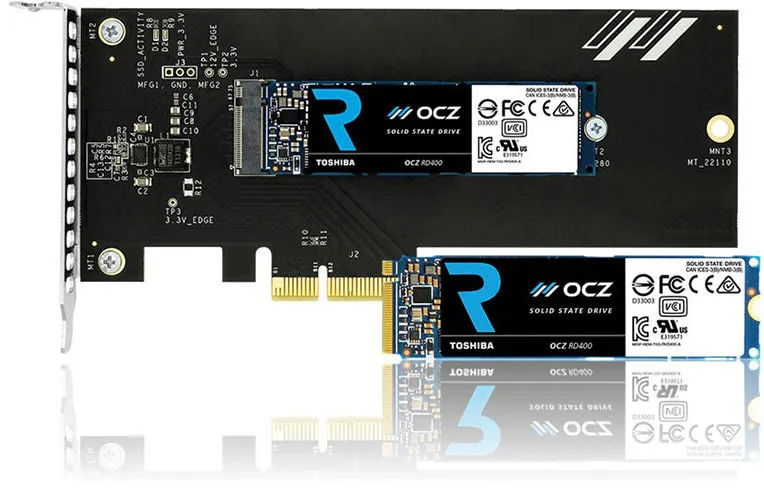
What happens when you combine Toshiba's NAND flash memory resources with OCZ's penchant for delivering enthusiast grade storage solutions? You end up with OCZ's RD400 series of NVMe solid state drives.
Toshiba says its OCZ RD400 series is one of its fastest consumer SSDs to date. That's not surprising since the bulk of solutions that have come beforehand have been SATA-based SSDs utilizing the legacy Advanced Host Controller Interface (ACHI) protocol, which predates SSDs.
The OCZ RD400 hitches its high speed wagon to the PCI Express Gen3 x4 lane where it's immune to SATA's comparatively low bottleneck. As a result, Toshiba advertises sequential read and write performance of up to 2,600MB/s and 1,600MB/s, respectively, along with 210,000 IOPS of random read and 140,000 IOPS random write performance (depending on the capacity).
"The RD400 gets back to the OCZ brand’s enthusiast roots and offers power-users, gamers, and professionals a cutting-edge storage solution designed to support demanding consumer applications," said Steve Fingerhut, senior vice president of Toshiba America's storage products business unit.
These drives feature Toshiba's 15nm multi-level cell (MLC) NAND flash memory and a controller that's built in-house, though Toshiba didn't provide any details on the latter. They're available in 128GB, 256GB, 512GB, and 1TB capacities.
Toshiba is selling these drives in standalone M.2 form for use in performance laptops, and also with an optional PCI Express adapter card for desktop users who lack an M.2. slot.
Here's how the pricing breaks down for each one:
- RD400 128GB w/ PCIe card: $130 (€130)
- RD400 256GB w/ PCIe card: $190 (€195)
- RD400 512GB w/ PCIe card: $330 (€360)
- RD400 1TB w/ PCIe card: $760 (€825)
- RD400 128GB: $110 (€150)
- RD400 256GB: $170 (€220)
- RD400 512GB: $310 (€380)
- RD400 1TB: $740 (€850)
The standalone 512GB model represents the best value at a cost of $0.60 per gigabyte, versus anywhere from $0.64 to $1 per gigabyte on the other models. Of course, these are MSRPs—street pricing could end up lower.
Each drive comes with a 5-year warranty.

