Our Verdict
The Arctis Nova Elite has some undoubtedly impressive drivers, and that's a very fine achievement. But its prohibitive price tag, in combination with a firm fit and a "see what sticks" approach to its feature set, fails to butter my parsnips. If it was cheaper, I'd like it a whole lot more. But for this sort of money? I don't think it justifies its massive MSRP.
For
- Snappy, crisp drivers
- Lots of goodies included
- Tight bass response
- Plenty of switching options
Against
- Waaaay too expensive
- Not very comfortable
- Fatiguing over long sessions
- Did I mention the price?
PC Gamer's got your back Our experienced team dedicates many hours to every review, to really get to the heart of what matters most to you. Find out more about how we evaluate games and hardware.
How much would you pay for a "luxury" gaming headset, with all the bells and whistles you could think of? Something that sounded great, with excellent battery life, plush earpads, ANC, and maybe even a separate DAC? Whatever the theoretical headset, I'd imagine the figure you just thought of would likely be far above $200, perhaps ranging into $300/$400 territory.
SteelSeries thinks you'll pay $600. That's how much the SteelSeries Arctis Nova Elite costs, and I've been told it's for the "ultimate gamer". Someone with an ultra-high end rig, a chair with all the massage functions, and presumably, a gold-plated gaming keyboard. Y'know, all the little extras.

Type: Closed-back
Connectivity: 2.4 GHz via included DAC, Bluetooth 5.3 + LC3+ LE Audio
Drivers: 40 mm brass surround + carbon fiber
Frequency response: 10-40,000 Hz
Mic: ClearCast Gen 2.X retractable boom mic, on-ear beamforming mic
Extras: Game Hub DAC with up to 96 kHz/24-bit audio processing and four outputs (3x USB Type-C, 1x line in, 1x line out), ANC, beamforming microphones, 2x swappable batteries with charging slot
Battery life: 30-hours per battery (swappable)
Weight: 380 g (headset)
Price: $600/£600
My review sample comes in a "Sage Gold" finish, for a start. It's a very trendy sort of colour combination, which reminds me of those Instagram influencers who wear grey yoga pants and gold jewellery while promoting dubious workout videos and nutritional shakes. It comes in Obsidian black, too, but I've been sent the achingly-hip one, which looks a little gaudy to my tastes.
The frame itself is made of aluminium and steel, with the headphone hangers on my particular unit coated in gooooooold. Well, gold paint, anyway. Those familiar with SteelSeries' other headset designs will find much of the same design language in this particular chassis, just with the odd upgrade. The volume wheel, for example, is now metal. Mine is also gold, of course, because why not.
The earcups themselves are still plastic, with magnetic plates on either side. These can be removed to expose the internal battery pack, which can be charged in a slot inside the included Game Hub/DAC/mixer combo. More on that later.
Putting the Arctis Nova Elite on for the first time reveals two things. One, it's a little heavy. Wearing a headset that weighs 380 grams in this day and age feels a touch old-fashioned, especially when the $150 (and remarkably good) Razer BlackShark V3 tips the scales at 270 g. Although the SteelSeries is still considerably lighter than the Maxwell 2, so it definitely gains points there.
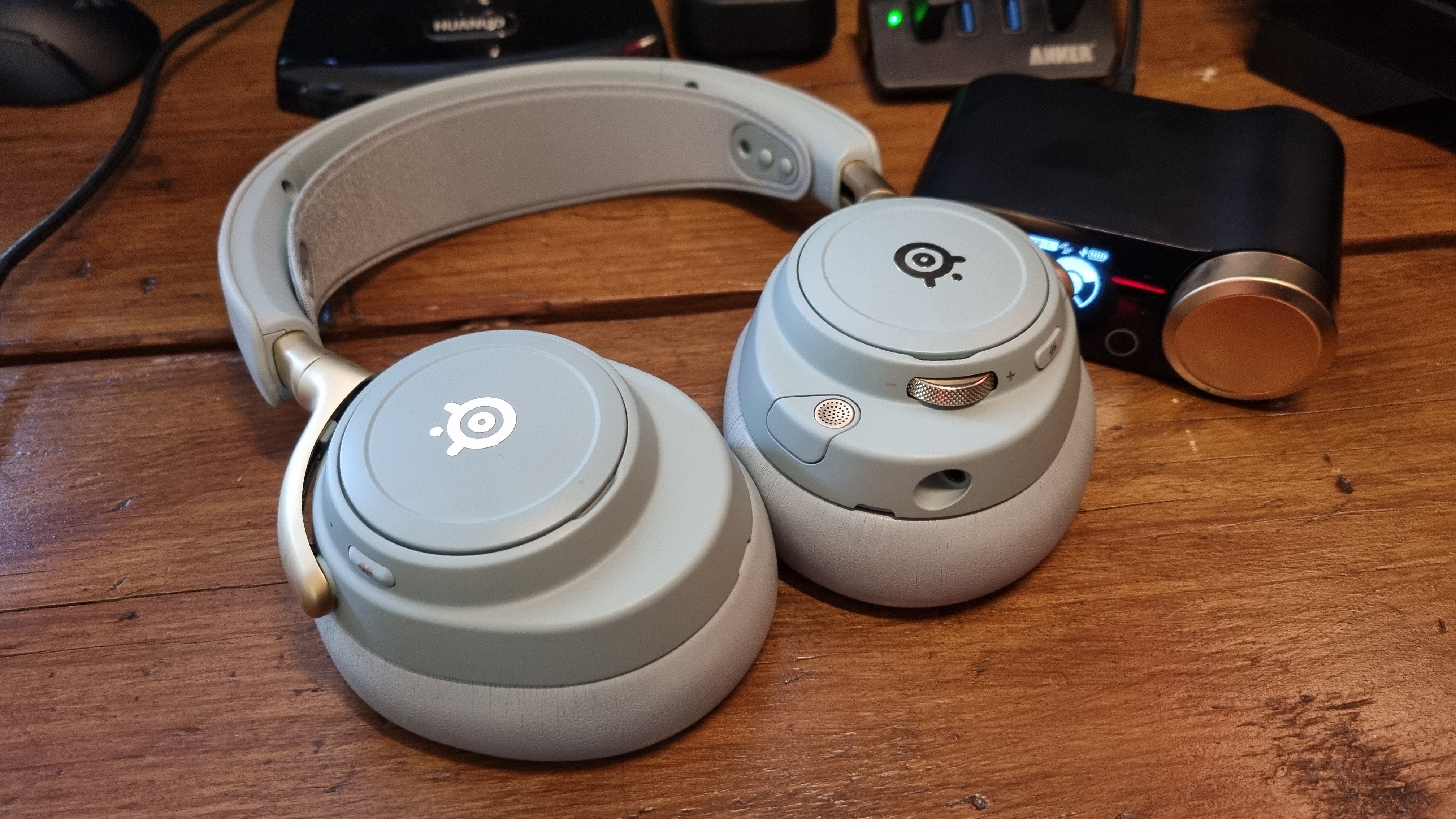
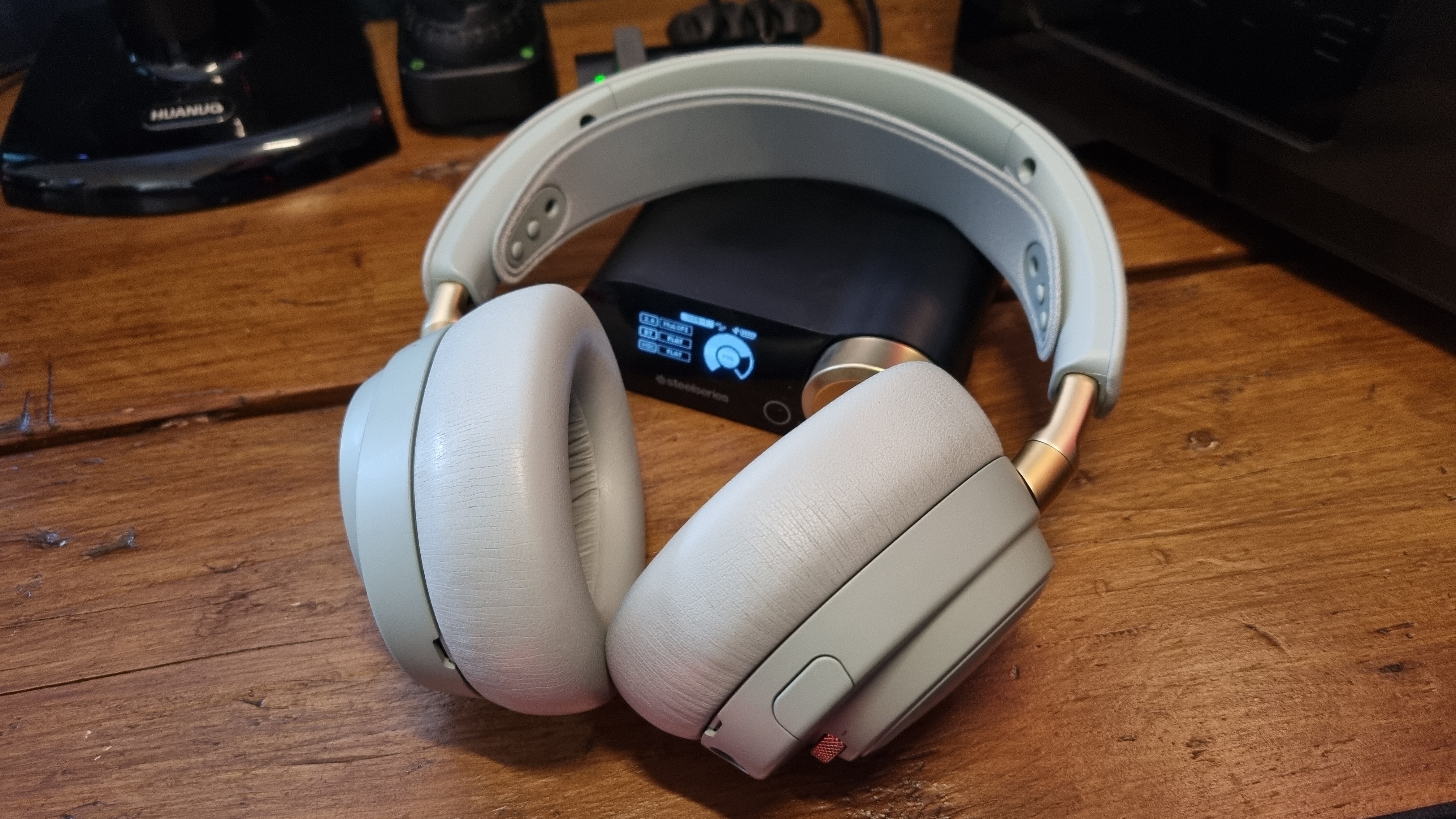
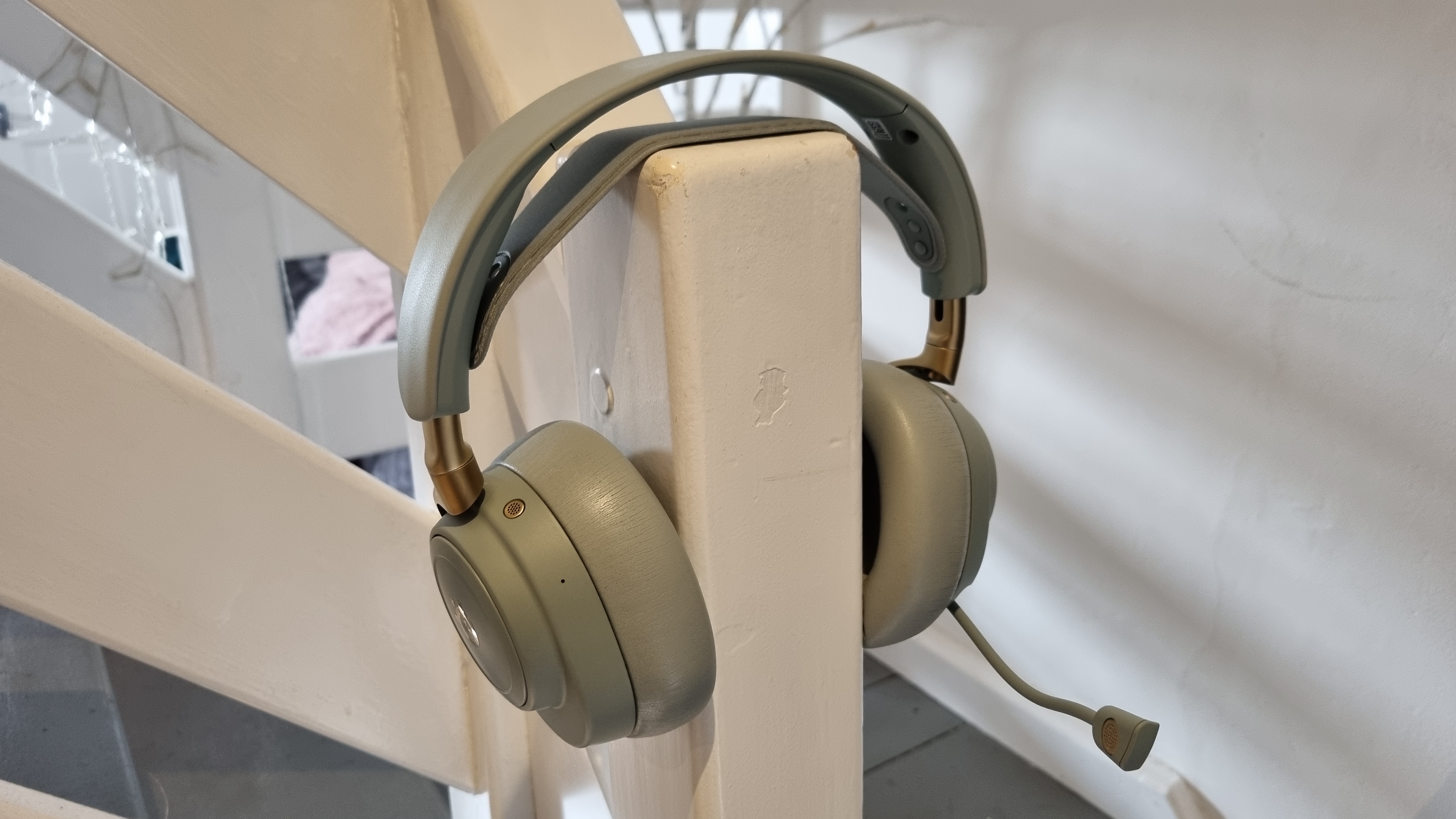
And two, it's not particularly comfortable. The vegan leather-clad earpads are very plush and squishy, so there's no issue there. But the clamping force is a little tight on my average-sized head, and the adjustment is rather stiff. The fabric inner headband material seems to have plenty of give (and yes, I checked I wasn't resting my skull on the outer band), but it still managed to make my head sore after a long day.
It feels a little unyielding, despite the squidgy earpad's best efforts. Still, the effect of those pads in combination with the tight clamping force means you get excellent passive noise isolation. The Arctis Nova Elite also has noise cancelling of the active variety, which SteelSeries claims is "the best in gaming".
SteelSeries has skipped its way across the pricing rubicon—and now finds itself competing with some seriously boutique gear
I'm not sure about that, but it's pretty good at isolating background noises, as far as ANC goes. Which is to say, low hums and fan noise are virtually removed, but a mechanical gaming keyboard or someone talking in the near vicinity will still cut through.
Thinking back to my recent reviews, I was more impressed by the ANC in the Sony Inzone H9 II, a $350 ultra-lightweight gaming headset I criticised for being too pricey. Oh, how naive I was back then.
Still, If you're paying audiophile-grade sums of money for a gaming headset, you expect audiophile-grade drivers, and it's here where this particular set starts to shine. SteelSeries has imbued the Arctis Nova Elite with two 40 mm carbon fiber units, complete with brass rings around the speaker cones. This essentially creates a pistonic effect, where the already-stiff driver stays rigid as it moves rather than wobbling around undesirably at the edges.

The aim here is to minimise distortion and create a punchy, ultra-pure frequency response, and in this regard, the Arctis Nova Elite truly succeeds.
These drivers really like to whack you around the eardrums. Jumping into a session of The Division 2, with its airy, post-apocalyptic soundscapes and crunchy weapon sounds, reveals a remarkably hair-raising response from these boutique units. It's also helped by the fact that SteelSeries' software supports custom, game-specific EQs, which in The Division 2's case, ups the bass levels and adds a sizable amount of impact to the treble.

Despite having a poor first experience with the Arctis Nova Elite's comfort levels, I can't help but be impressed with its sonic capabilities. Footsteps become very easy to hear and position, and I found myself jumping at knocked over traffic cones or the odd deer skipping its way through the deserted streets of Washington DC. The sensation can be quite physical, in a way that most traditional gaming headsets fail to achieve.
However, there is a downside to this aggressive response. After an hour or so, I found myself tweaking the EQ back to a more flattened, neutral-like setting, as the drivers can become quite fatiguing to listen to over long periods.
Planar magnetic-bothering? Nah, not quite
Even flattened out and with the volume lowered, though, you can still tell that these ultra-stiff units are pushing air into your lugholes with unrelenting precision—and this, in combination with the firm clamping force, left me feeling a little beaten up.
Musically, the SteelSeries set calms down a little. This is helped by the music-focussed EQs in the software, which includes Afrobeats, K-Pop, Synthwave, and Trap among the more traditional musical genre settings. Most of these EQs are fairly gentle, which in turn tames the drivers into a softer response.

Accuracy-wise, the SteelSeries set is rather good for music listening. It's missing a little sweetness, though, a little of the golden, "gosh these are lovely" responses I'd expect to hear from really expensive, yet consumer-friendly, audiophile gear. Still, it's undoubtedly an impressive set to listen to, with clear treble, a tight bass response, and a wide soundstage.
Planar magnetic-bothering, though? Nah, not quite. There's a slight sterility to the sound that's difficult to tune out, and I can't help but feel the ultra-stiff design of the carbon fiber drivers is to blame. Perhaps they'll loosen up over time, but as best as I can tell, keeping things tighter than a very tight thing is the ultimate goal here.
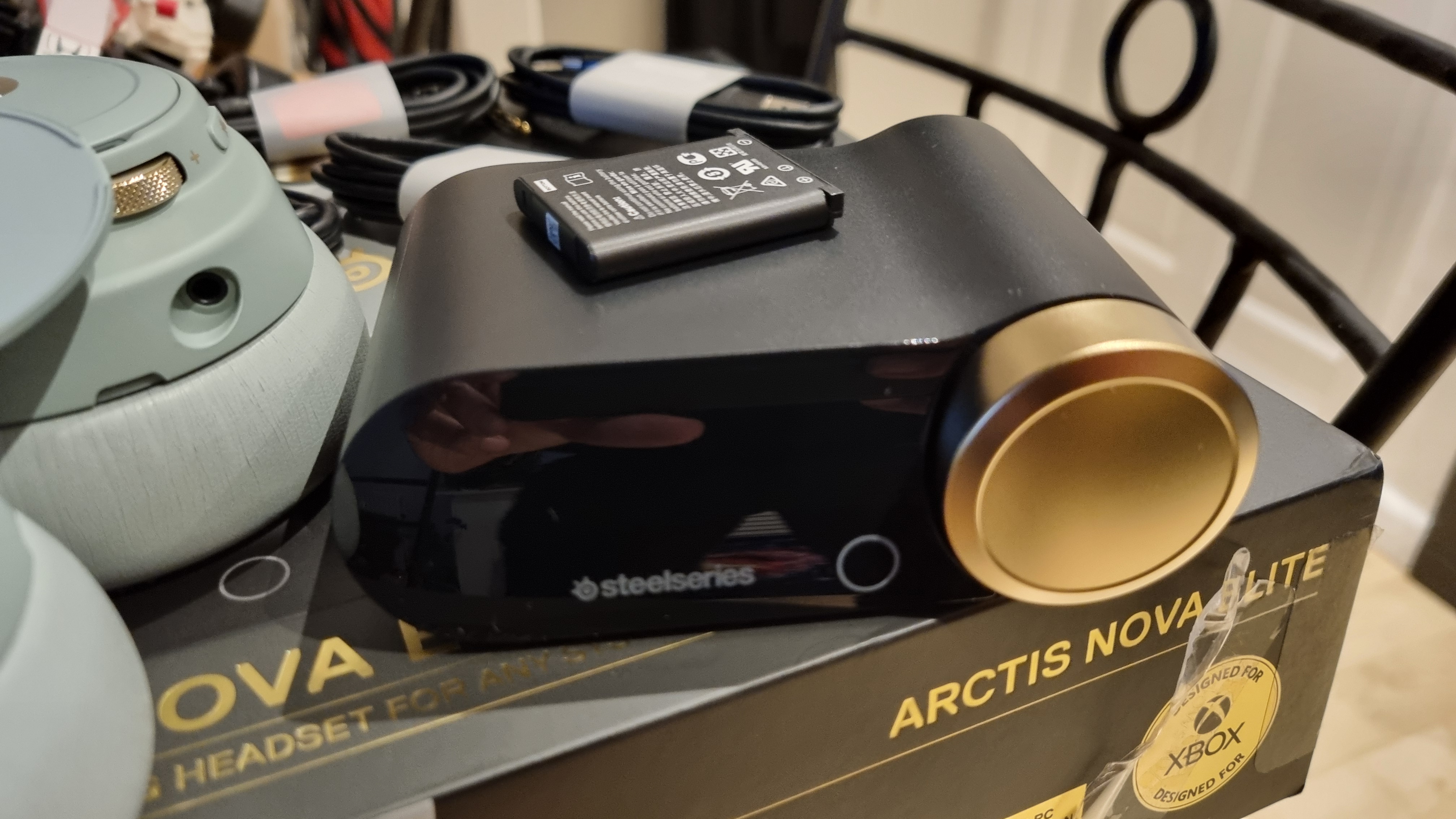
So, it doesn't really justify its massive price tag in the audio department, either. However, there are a few more tricks up the Elite's sleeve, and many of them revolve around the included Arctis Nova Elite Game Hub. This is essentially an upgraded DAC unit with support for up to 24-bit, 96 KHz audio transmission.

You can also switch between four audio sources through its three USB Type-C ports and twin line in/line out 3.5 mm connections, and it comes with a big shiny knob to control them, alongside the volume.
Mine occasionally squeaks as I swap batteries into it, which doesn't quite gel with the whole "ultra-premium" concept
It functions perfectly well, and is quite a handsome device to have sitting on your desk. SteelSeries envisages you swapping between connection sources on the fly while, say, waiting in a game lobby, so you can handily switch to another source for some music-listening, YouTube watching, or otherwise. It does so just fine, but I'm not sure it represents a huge amount of extra utility, even for a "luxury" gamer.
What is useful, however, is the built-in battery charging slot in the side. SteelSeries provides you with two battery packs, which means you can swap them in and out in moments to keep gaming into the early hours.
You get up to 30-hours of charge out of a single pack, and it takes between two to three hours to charge one fully from zero percent. Mine occasionally squeaks as I swap batteries into it, which doesn't quite gel with the whole "ultra-premium" concept.

Still, it's a nice feature—albeit one we've seen before in the SteelSeries Arctis Nova Pro, a $350 headset with lesser, but still quite impressive drivers. In fact, the Arctis Nova Pro is perhaps the biggest counterpoint to the Elite's prohibitive price tag. It's missing a fair few of the latter's features, but it's still got a decent selection of the highlights.
One of the things it's missing, though, beyond carbon fibre eardrum-pushers, is the Elite's set of beamforming mics. These work separately from the upgraded retractable boom mic, so you can take the Elite out in public using the Bluetooth 5.3 connection and answer calls without looking like a plum.
Like all beamforming mics, these units provide a hollow, but somewhat-usable sound quality. The boom mic itself has been upgraded to support 32 KHz, 16-bit transmission, and in combination with Sonar AI noise cancelling, it sounds... fine. A bit midrangey and compressed to my ears, but fine. Nothing spectacular.
Arctis Elite boom mic - AI noise cancelling on, default EQ
Arctis Elite beamforming mics - AI noise cancelling on, default EQ

And that's really the whole crux of my issue with the SteelSeries Arctis Nova Elite. Most of its features sit in the "nothing spectacular" category, with the exception of those remarkably punchy drivers. I'd really like a set of those in one of SteelSeries' more affordable models, as I think they're a genuinely impressive achievement, even if they're not quite as sweet-sounding as I'd like.
But I don't want to pay $600 for them. And despite the fact that SteelSeries has clearly thrown the kitchen sink at this set to justify its price tag, I can't shake the feeling that it's charging such a hefty sum because, well, it can.

While there are certainly gamers who will pay vast sums for their gear because "it's the best", when it comes to headsets, SteelSeries has skipped its way across the pricing rubicon—and now finds itself competing with some seriously boutique gear.
✅ You want a feature list that goes on for days: SteelSeries has really thrown the kitchen sink at the Arctis Nova Elite, and that means you get future-ready hi-res audio support, ANC, battery swapping, and much, much more.
✅ You want an aggressive audio response: The carbon fiber driver units can reproduce a remarkable amount of detail, and happily fire audio at your eardrums with heft. It can be fatiguing to listen to, but it's impressive nonetheless.
❌ You're on any sort of budget: If money is no issue to you at all, the SteelSeries set is perhaps worth considering thanks to its wide feature set and its detail-focussed drivers. Anyone else would be better off spending their money elsewhere.
❌ You want all-day comfort: Your mileage may vary here, but my average-sized head finds the clamping force a little too much—and that, combined with the weight, makes for an uncomfortable fit.
If that's the way you plan on spending your cash, you've got some incredible options to consider. Beyond the Maxwell 2, there's the Beyerdynamic MMX 330 Pro. It's a wired set, but its drivers are gorgeously well-refined, it's got a broadcast-quality mic, and it's as comfortable as an old sofa. Yours, for $330.
There's also the Drop+Epos PC38X, an excellent-sounding set that also requires a cable, but is fabulously lightweight and surprisingly well-priced, at $139. Or the Sennheiser HD650, a mic-less set with superb responses, proper audiophile credentials, and a $400 price tag. Or the $250 Razer BlackShark V3 Pro, if ANC and wireless connections are absolute necessities, complete with Razer's fantastic 50 mm TriForce Bio-Cellulose drivers.
Or, y'know, you could spend much, much less on any of the excellent options in our best gaming headsets list. They're not all audiophile stunners, but each is exceptional in its class.
And yes, I know what you're thinking—each of those sets has something missing compared to the Arctis Nova Elite. But when the price tag is this prohibitive, I know I'd rather miss out on a few features and put the saved cash towards some other peripherals (or some better components) instead. If you've got all the money in the world, the Elite is perhaps worth some consideration. Otherwise, though? Your cash is better spent elsewhere.
If the Elite was $400, I'd likely give it a much higher score. But $600 for a headset that isn't particularly comfortable, with an average mic and great drivers that nonetheless fail to set my inner audio nerd ablaze, really does feel like taking the mickey. Sorry, SteelSeries. Stick those carbon fiber units in something that costs significantly less than an RTX 5070, and then we might be talking.
1. Best overall:
Razer BlackShark V3
2. Best budget:
Corsair HS55 Stereo
3. Best wired:
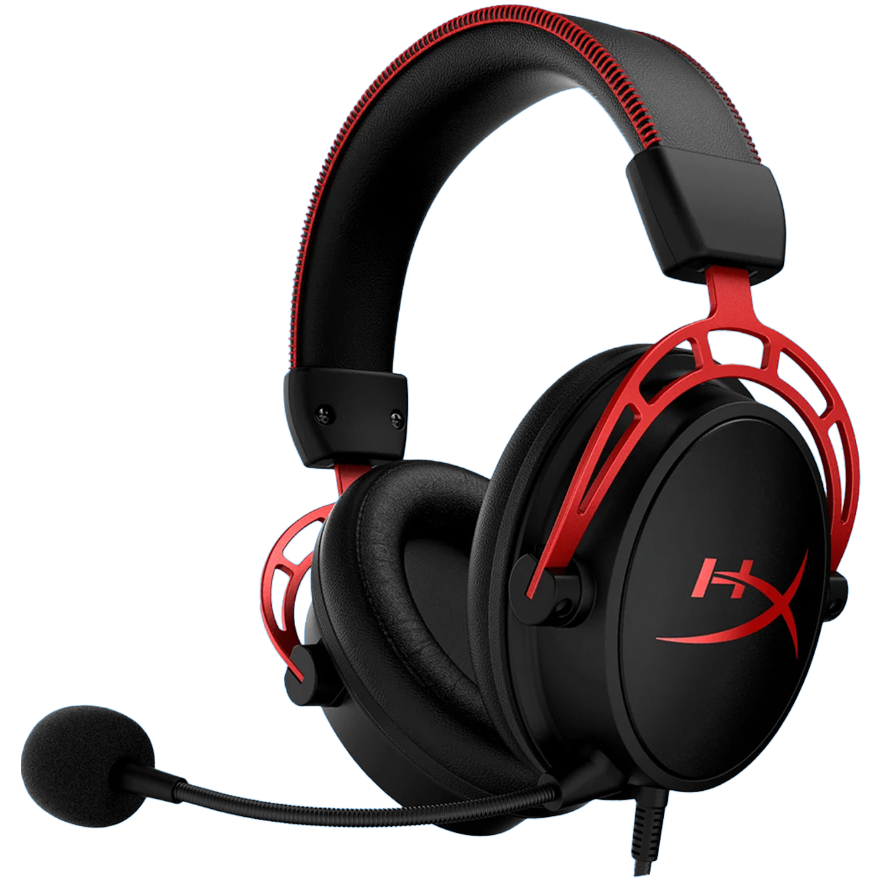
HyperX Cloud Alpha
4. Best mid-range wireless:
Turtle Beach Stealth 600 Gen 3
5. Best audiophile:
Beyerdynamic MMX 330 Pro
6. Best wireless audiophile:
Audeze Maxwell
7. Best for streaming:
Audio-Technica ATH-M50xSTS StreamSet
8. Best noise-cancelling:
AceZone A-Spire
9. Best earbuds:
Steelseries Arctis GameBuds
The Arctis Nova Elite has some undoubtedly impressive drivers, and that's a very fine achievement. But its prohibitive price tag, in combination with a firm fit and a "see what sticks" approach to its feature set, fails to butter my parsnips. If it was cheaper, I'd like it a whole lot more. But for this sort of money? I don't think it justifies its massive MSRP.

You must confirm your public display name before commenting
Please logout and then login again, you will then be prompted to enter your display name.