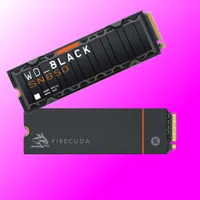
Anyone who has been keeping a close eye on SSD prices will know that they've always followed a neverending cycle of going up-up-up, then down-down-down, before climbing back up. Right now we're at the zenith of this pattern but thanks to an excess of production and lower-than-expected demand, it's expected that the price rollercoaster will start a period of decline by as much as 15%.
That's according to a new report by Trendforce, a market research and analysis firm, that specialises in all things electronic. It notes that while demand for enterprise-level SSDs has been as high as ever, driven by the explosion in AI computation, the consumer sector has been decidedly uninterested in buying lots of shiny new SSDs.
The distinct lack of interest in client-based AI stuff (aka AI PCs) hasn't helped matters either and Trendforce expects that SSD contract prices will fall between 5 and 10% over the next three months. Every week, we search through all the major retailers for the best prices on the best gaming SSDs and I have to say that given how volatile some models have been, any reduction will be welcome.
However, Trendforce also notes that over the past three months, consumer-grade SSD prices have generally gone up by 8 to 10%, so this reduction will just negate that increase. In other words, we probably won't see cheaper SSDs on shelves just yet.
What should swing matters in our favour, though, is the fact that Trendforce expects an overall decline in contract prices for all NAND flash products, with the exception of server-grade stuff. But even that will only increase by a few percent. Altogether, the excess in flash chips and lower demand should pull wafer prices down, by as much as 15%.
Admittedly that's not a huge drop but it does indicate that we're about to move into a period where NAND flash products (SSDs, memory sticks, phone storage, etc) will all slowly drop in price. That will probably take anywhere between six and nine months to fully come to light, and by then, flash manufacturers such as Samsung and Micron, will ease off on production to decrease wafer inventory more than they already have.
New PCIe 5.0 SSDs should make an appearance in 2025 and it's generally expected that they will run a lot cooler than current models, which all have a tendency to get seriously scorchio when under load. Should that all come to pass, demand will pick back up but thanks to the reduced inventory, prices will then start to rise again.
Thus, the neverending cycle of SSD prices will continue for another 12 to 24 months, just as it has ever done. I suppose we should be thankful that solid state storage hasn't gone the way of motherboards and GPUs, which all seem painfully expensive these days. And one doesn't need a hot-snotting Gen5 SSD to enjoy fast load times in a gaming PC; any of the best SSDs around right now are more than good enough.