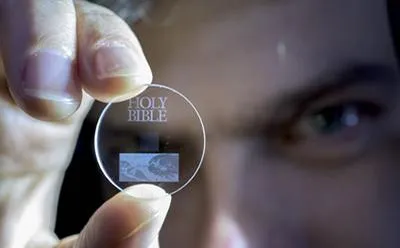
Experimental 5D data storage could store 360TB of games for 13.8 billion years
Keep up to date with the most important stories and the best deals, as picked by the PC Gamer team.
You are now subscribed
Your newsletter sign-up was successful
Want to add more newsletters?
Every Friday
GamesRadar+
Your weekly update on everything you could ever want to know about the games you already love, games we know you're going to love in the near future, and tales from the communities that surround them.
Every Thursday
GTA 6 O'clock
Our special GTA 6 newsletter, with breaking news, insider info, and rumor analysis from the award-winning GTA 6 O'clock experts.
Every Friday
Knowledge
From the creators of Edge: A weekly videogame industry newsletter with analysis from expert writers, guidance from professionals, and insight into what's on the horizon.
Every Thursday
The Setup
Hardware nerds unite, sign up to our free tech newsletter for a weekly digest of the hottest new tech, the latest gadgets on the test bench, and much more.
Every Wednesday
Switch 2 Spotlight
Sign up to our new Switch 2 newsletter, where we bring you the latest talking points on Nintendo's new console each week, bring you up to date on the news, and recommend what games to play.
Every Saturday
The Watchlist
Subscribe for a weekly digest of the movie and TV news that matters, direct to your inbox. From first-look trailers, interviews, reviews and explainers, we've got you covered.
Once a month
SFX
Get sneak previews, exclusive competitions and details of special events each month!
You know that game you keep coming back to, no matter how much you've played it already? Thanks to a new data storage technology called 5D, you'll be able to store it on a tiny piece of nanostructured glass and load it up again a long, long time from now. Say, 13.8 billion years.
Researchers at the University of Southampton have developed the technique, which involves femtosecond (that's a quadrillionth of a second) laser writing. The file is written in three layers of dots separated by five microns (one millionth of a meter).
The nanostructured glass the data is written to has a 360TB capacity, and thermal stability up to 1000 degrees Celsius. At temperatures below 190 degrees, the data will last for 13.8 billion years. The glass changes the way light passes through it, and the different polarizations can be read by an optical microscope and a polarizer. University of Southampton writes:
"Coined as the ‘Superman memory crystal’, as the glass memory has been compared to the 'memory crystals' used in the Superman films, the data is recorded via self-assembled nanostructures created in fused quartz. The information encoding is realised in five dimensions: the size and orientation in addition to the three dimensional position of these nanostructures."
A pocketful of these discs could archive every PC game ever made, although we expect getting a R/W drive for your PC might be a tad expensive 50 years from now.
So far, the likes of the Universal Declaration of Human Rights, the Magna Carta and the King James Bible are in 5D storage, so it's probably only a matter of time before you can get Minecraft on a little glass disc.
Keep up to date with the most important stories and the best deals, as picked by the PC Gamer team.

