





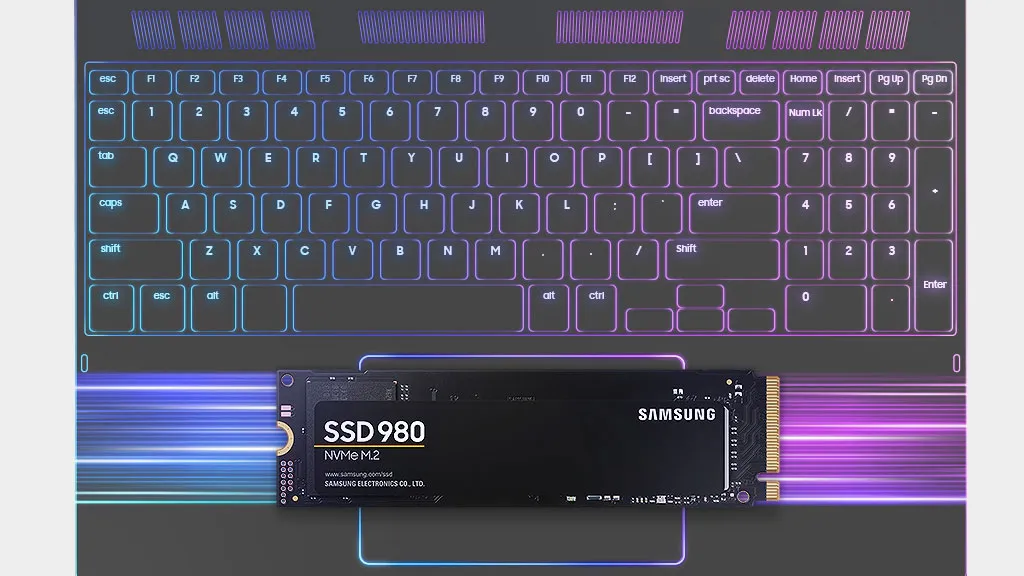
Sold state drives that lack onboard DRAM to help with caching and other housekeeping chores are about to become even more commonplace, as PC makers "increasingly adopt" the cheaper storage in light of rising DRAM costs. In theory, this means PC makers will not have to skimp on storage or charge a premium for higher storage capacities, though there are caveats. One of them is performance.
One of the tasks of a DRAM buffer is to keep a map of stored data on an SSD. This can help the operating system and apps more quickly pinpoint where specific bits are located. DRAM also helps with write performance. All other things being equal, an SSD with DRAM is going to be faster than an SSD without DRAM in certain situations.
Citing unnamed industry sources, the folks at Digitimes say OEMs plan to stuff their entry-level and midrange laptops and desktops with DRAM-less SSDs. DRAM supply is tight, so I imagine going this route ensures they can continue to offer the same capacities as we have grown accustomed to—seeing a 512GB SSD in an affordable laptop or desktop is no longer rare these days.
The apparent rumblings coincide with a TrendForce report saying PC DRAM contract prices are about to see a "remarkable" price increase next month. Contract pricing already jumped by as much as 8 percent this quarter, and next quarter (which starts in April), various types of DRAM will go up "more significantly," to the tune of 13-18 percent.
"At the moment, the DRAM market has formally entered a new cycle of rising prices, and 2Q21 will see larger QoQ price increases compared with 1Q21," TrendForce says.
On the plus side, even a DRAM-less SSD can be relatively fast. Take for example Samsung's new 980 SSD (non-Pro model). We reviewed the 1TB model and while there was nothing to really get excited about in comparison to faster PCIe 4.0 models we've tested, and even some PCIe 3.0 drives, we found the performance to be perfectly acceptable for what it is—a PCIe 3.0 SSD without any DRAM.
In our testing, we saw sequential writes hit 2,640MB/s in ATTO and 2,553MB/s in AS SSD. There are certainly faster PCIe 3.0 drives out there, but consider that even the best 2.5-inch SATA SSDs will top out at around 550-580MB/s. Viewed from that perspective, the 980 is a peppy drive.
Not all SSDs are created equal, of course, so we'll have to wait and see what specific DRAM-less drives PC makers employ. In addition, drive makers have touted advances in DRAM-less SSDs. As explained by Western Digital (PDF), this "allows SSDs to utilize some of the DRAM attached to the host, or central processing unit (CPU), through the PCIe connection" rather than requiring onboard DRAM.
WD conducted a study to see if users could discern a difference between SSDs with and without DRAM, in day-to-day activities.
"While their behavior on the computer varied, the results were consistent—there was no noticeable change in performance," WD concluded.
Obviously WD has a vested interest in the reported outcome, but outside of tasks that rely on exceptional write performance, we would expect there to be little discernible difference.

