 Join The Club





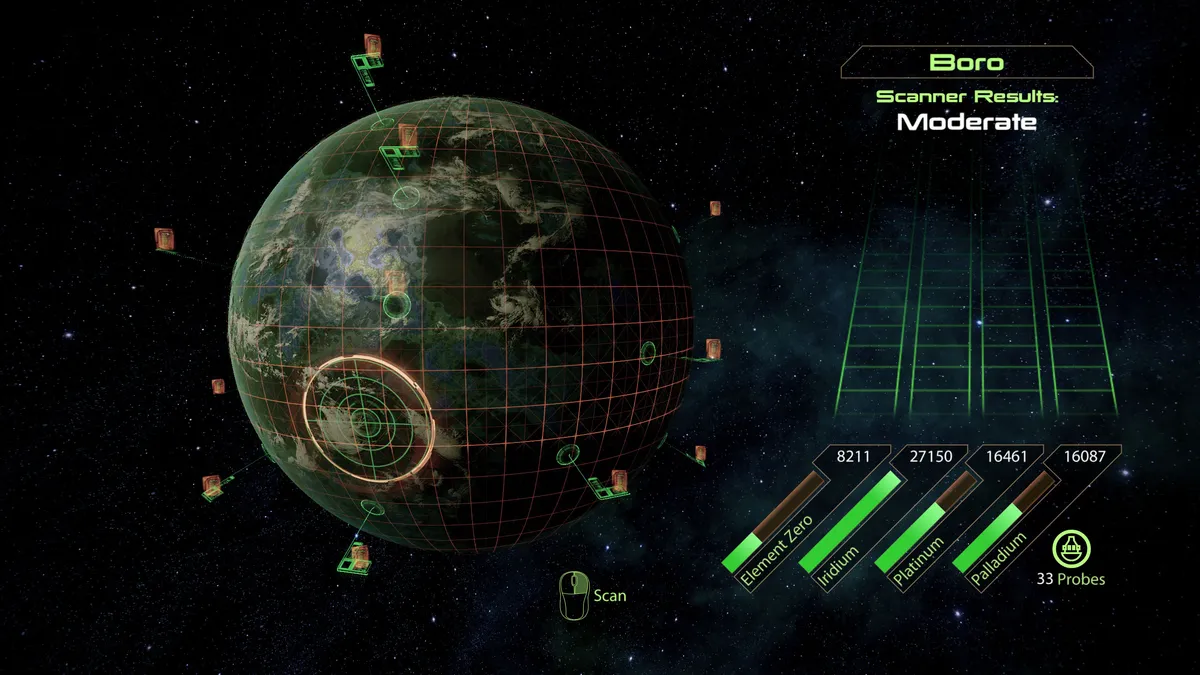
Most people scoff a bit when I tell them that one of my favourite things about Mass Effect 2 is scanning planets. I get it—the whole act of clicking on a planet, watching a transition screen, turning said planet around its axis for a while until you’ve found a mineral deposit and then listening to the same lines over and over again as your probe launches isn’t exactly a rousing experience. It doesn’t have to be.
The Mass Effect universe is an accomplished piece of world building. The moment I step into Shephard’s boots, I have a personal history that ties me to the achievements of the human race in outer space. Humans made first contact with new species, became represented in an interplanetary council and can basically go wherever they please. But the Mass Effect saga is also about uncharted space, showing us that for all that humans have seen and built, there’s always more of space to be discovered.
To me, scanning planets is about discovery, in the most scientific sense of the word. It is, like Spock’s technobabble in Star Trek, an important part in delivering a fully realised world. Of course there is no practical use to me as the player in knowing the radius and day length of some random planet, but without them, it wouldn’t be a planet.
Article continues belowAll shapes and sizes
The codex entries for planets consist of two different sets of data: a set of numbers describing the planet by parameters such as atmospheric pressure and surface gravity, and a description of whatever has been discovered during previous expeditions, such as the soil quality or any life forms present. It’s the kind of background info doomed to go unread but stuffed with detail all the same, which makes me love it more. Imagine the effort and dedication that goes into making whole solar systems worth of planets with different conditions—an immense world building endeavour—all just for you to scan a planet and siphon off a few stones.
From a mechanical perspective, scanning is a more economic and far less tedious alternative to going down to a planet in your Mako and driving around until you find minerals (hate!), the way you do in the original Mass Effect. It’s supposed to be a quicker and more efficient form of resource gathering, grounded in the realities of spaceflight.
I’d go as far as to say scanning could be intentionally boring, because not every job on a spaceship involves going pew, pew, pew. But imagine a crew hanging tiredly over their consoles logging the data of one more planet scan, suddenly faced with a major discovery.
Take the planet 2175 Aeia, a name that sounds like a keyboard smash. After a cursory flyby, nothing noteworthy was recorded, until you go back and scan the planet again, only to discover that its atmospheric composition is very close to that of Earth. Have you just discovered a new habitat for humans? What kind of species already call this planet their home? Those are the kind of questions I can’t get enough of.
Infinity and beyond

Some planets, like Parnassus, are simply not in the Citadel database due to bureaucratic snafu, which makes me think about how even space conquest is nothing without a good backend filing system. Mass Effect 3 and Mass Effect Andromeda even go a step further and tell more detailed stories of how the planets fit into the world, detailing noteworthy history of who lives there or what happened to render a planet inhabitable. Whenever I find a rusty spaceship or satellite, I imagine the mighty storms that might have ripped them apart, whole stories that played out before I uncover the debris.
Scanning planets in Mass Effect 2 shows that even at a time when devs have the storage capacity and graphical capabilities to let players run wild and explore even the most detailed world, what really inspires the imagination is to sometimes not be able to look at something—the same way the vague shadows in the original Silent Hill were way scarier to me than the bright, crystal-clear HD version.
I dream of the stars and the life undiscovered, but I imagine there will be a lot of scanning before we meet our first alien, too.

