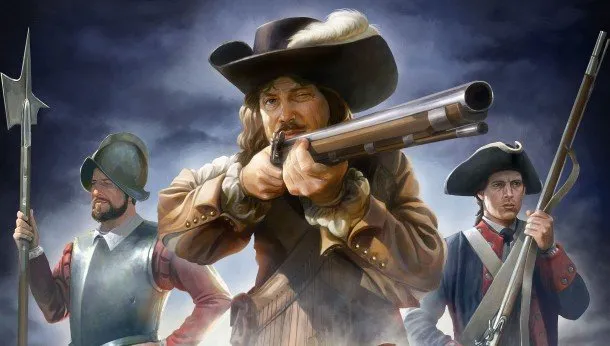
I’ve logged a few hundred hours on Europa Universalis 4 and an embarrassingly large number on its predecessor. All as England, mark you. However, despite my now-intimate familiarity with the politics of the early modern period, I’ve never once seen the end of the game. Oh yes, there is an end—the dawn of 1821 throws up a results card to congratulate you on four centuries of imperialism. The 19th century’s not for me though. I tend to switch off just as gunpowder becomes fashionable.
Intimidating before you get into them, you quickly find that Paradox games are all about the story. Your story. Your impossible, anachronistic retelling of history to suit whatever mood you’re in. Blame it on the genes, but I’m frequently in a colonial mood and consider northern France unclaimed wilderness.
Yet it won’t do to rock up in Paris as some puny English king who barely escaped the Hundred Years’ War with his head. I feel compelled to birth a mightier nation as a statement of intent. Leinster, Tyrone, Connacht and Munster are soon guzzled up, provoking Scotland, which typically forms an ill-advised alliance with the above out of spite. I’m bezzies with Portugal, though, so they keep the home counties tartan-free while I’m abroad. With Scotland exhausted by Portuguese troops, I stroll in and make Edinburgh my second city. Thus, the United Kingdom is born.

This is a sequence I’ve played a dozen times, but I never get tired of it. Contending with EU4’s tangle of stats is a complex dance—there’s always a step you could have done better, more efficiently or have added extra flourish to.
By the time my diplomats have somehow convinced everyone that Île-de-France should belong to the British, I’m no longer interested in the end goal. My mind has wandered back to how I might farm Scots for cash before breaking them completely, or whether I should have marched into Norway for the sole reason of reclaiming Orkney.
America can found itself, and I think it’s entirely for the best that the British stay out of Africa. No, my Britain is a perpetual backwater, aspiring to greatness, setting devious plans in motion but forever limited by pathological perfectionism. That things are still going wrong on the umpteenth attempt is why I love starting fresh in Europa Universalis.