14 years later Resident Evil 5 finally removes Games for Windows Live and restores splitscreen
"Well isn't this one big family reunion."

Keep up to date with the most important stories and the best deals, as picked by the PC Gamer team.
You are now subscribed
Your newsletter sign-up was successful
Want to add more newsletters?
Every Friday
GamesRadar+
Your weekly update on everything you could ever want to know about the games you already love, games we know you're going to love in the near future, and tales from the communities that surround them.
Every Thursday
GTA 6 O'clock
Our special GTA 6 newsletter, with breaking news, insider info, and rumor analysis from the award-winning GTA 6 O'clock experts.
Every Friday
Knowledge
From the creators of Edge: A weekly videogame industry newsletter with analysis from expert writers, guidance from professionals, and insight into what's on the horizon.
Every Thursday
The Setup
Hardware nerds unite, sign up to our free tech newsletter for a weekly digest of the hottest new tech, the latest gadgets on the test bench, and much more.
Every Wednesday
Switch 2 Spotlight
Sign up to our new Switch 2 newsletter, where we bring you the latest talking points on Nintendo's new console each week, bring you up to date on the news, and recommend what games to play.
Every Saturday
The Watchlist
Subscribe for a weekly digest of the movie and TV news that matters, direct to your inbox. From first-look trailers, interviews, reviews and explainers, we've got you covered.
Once a month
SFX
Get sneak previews, exclusive competitions and details of special events each month!
Out of nowhere Capcom has released an update for the Steam version of Resident Evil 5, released in 2009, the main function of which is to strip-out the zombified corpse of Games for Windows Live. The latter was an ill-fated online service that linked PCs into Microsoft's Live services—launched in 2007 and discontinued in 2014—which mainly served to annoy users with its lack of functionality and compatibility problems. Indeed, a theme in the aftermath of its closure was games one-by-one updating to remove the service.
Well Capcom took their sweet time (this is the first Resi 5 update since 2017) but it's clear why this was on the to-do list: the presence of GfWL meant an in-built feature of the game had to be disabled. Resident Evil 5 launched as a GfWL title, with split-screen co-op included, but when ported to Steam the GfWL layer caused problems with player data and meant that the option was disabled (though there were workarounds with mods).
It's always been a little odd, because co-op was baked-in to Resi 5 and the key differentiator with what had gone before. The fundamentals are carried-over from the peerless Resident Evil 4 (and doesn't the remake of that look hot) but Resi 5's schtick was two playable protagonists and a campaign that could be played the whole way through with a buddy.
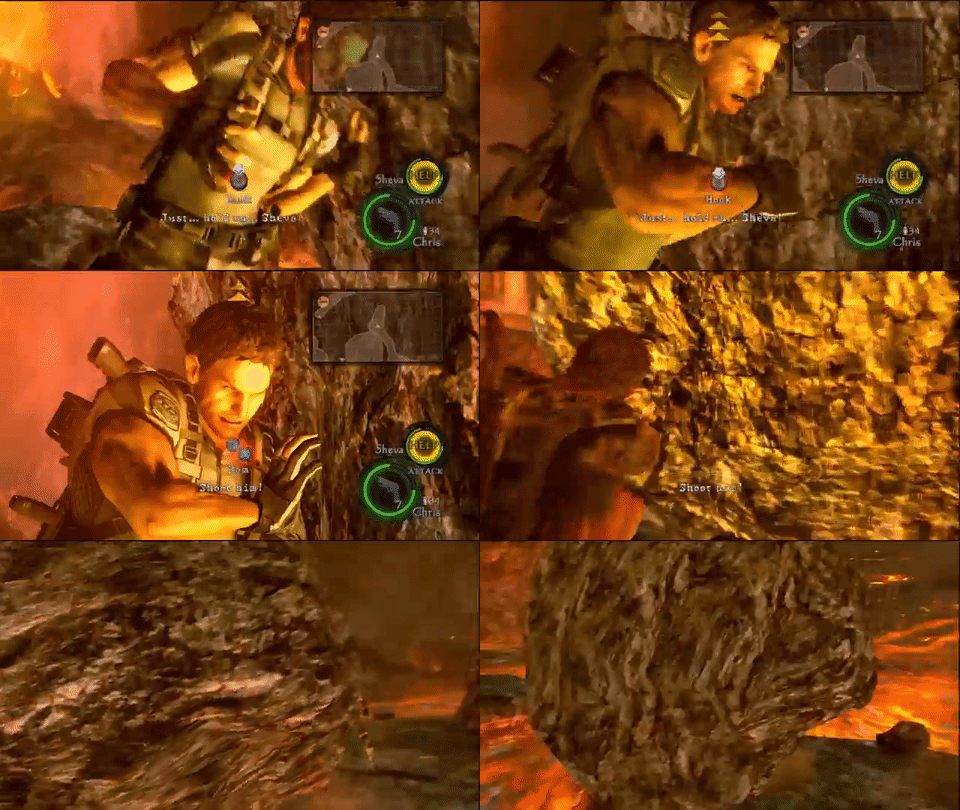
The game sometimes gets a bad rap, mainly because it's not as good as its classic predecessor, but in co-op it's a great time and the game goes so OTT at the end you can't help but laugh. This is the one where Chris literally punches back boulders, and you kill the final boss by shooting him with a rocket as he's burning in a volcano.
The patch notes mention "other minor bug fixes", though no indication of what they are. So a small surprise, but a welcome one. My anticipation for the upcoming Resident Evil 4 remake is white-hot and, if you're the same, maybe a little runthrough of this in co-op will help ease the wait.

Keep up to date with the most important stories and the best deals, as picked by the PC Gamer team.

Rich is a games journalist with 15 years' experience, beginning his career on Edge magazine before working for a wide range of outlets, including Ars Technica, Eurogamer, GamesRadar+, Gamespot, the Guardian, IGN, the New Statesman, Polygon, and Vice. He was the editor of Kotaku UK, the UK arm of Kotaku, for three years before joining PC Gamer. He is the author of a Brief History of Video Games, a full history of the medium, which the Midwest Book Review described as "[a] must-read for serious minded game historians and curious video game connoisseurs alike."